FIGURE 7.15 Effect of pressure gradient on wind speed. Image Copyright: Michael Pidwirny.
Wind can be defined simply as air in motion. Near the Earth’s surface, the speed of this air movement can vary from absolute calm to speeds as high as 407 kph (254 mph) (a three-second gust measured by an anemometer at Barrow Island, Australia, April 10, 1996). Wind can be in any direction, horizontally (side to side) and vertically (up and down). In most cases, the horizontal component of wind flow greatly exceeds the vertical component.
Wind develops from spatial differences in atmospheric pressure. We discovered in the previous section that changes in air pressure can be driven by various factors, including changes in air temperature (Figure 7.11). Consequently, wind speed tends to be greatest during the daytime, when the greatest spatial extremes in atmospheric temperature and pressure occur.
Wind is often described by two characteristics: wind speed and wind direction. Wind speed is the velocity attained by a mass of air traveling horizontally. Wind speed is usually measured with ananemometer in kilometers per hour (kph), miles per hour (mph), knots, or meters per second (mps) (Figure 7.12). Wind direction is measured as the direction from which the wind comes. For example, a southerly wind blows from the south to the north. A wind vane is an instrument used to measure wind direction (Figure 7.12). Both instruments are positioned in the environment at a standard distance of 10 m above the ground.
Winds are named according to the compass direction of their source. Thus, a wind from the north blowing toward the south is called a northerly wind. Figure 7.13 describes the sixteen principal bearings of wind direction. Most meteorological observations report wind direction using one of these sixteen bearings.
Newton’s Laws of Motion
To understand how wind forms, we must recognize that it is the product of only a few forces. We must also understand that specific fundamental laws of nature control the action of these forces. Sir Isaac Newton, in the year 1670, was the first scientist to describe these laws theoretically. Newton's First Law of Motion suggests that a stationary object will remain stationary, and an object that is in motion will stay in motion as long as no opposing force is put on the object. As a result of this law, a puck sent in flight from a hockey stick's blade will remain in motion until friction slows it down or the goalie makes a save. This law also suggests that once in motion, an object's path should be straight unless it is altered in its direction by another force.
Newton's Second Law of Motion suggests that the force put on an object equals its mass multiplied by the acceleration it achieves. The term force in this law refers to the total or net effect of all the forces acting on an object. Mathematically, this law is written as:
Force = Mass x Acceleration
or
Acceleration = Force/Mass
From this law of motion, we can see that the acceleration of an object is directly proportional to the net force pushing or pulling that body and inversely proportional to the body's mass. Thus, the greater the force created by the movement of a hockey player's stick, the faster the puck will travel. This law also suggests that if the player used a larger (more massive) puck, more force would be required to get it to travel as fast as a smaller one.
We now have a basic understanding of how an object (with mass) will react to a force in terms of motion. We can now apply this knowledge to discover how a small number of forces are responsible for generating wind on our planet.
Pressure Gradient Force
Horizontally, at the Earth's surface, wind always travels from areas of high pressure to areas of low pressure (vertically, winds move from low pressure areas to high pressure). This situation is comparable to an individual skiing down a hill. The skier will, of course, move from the top to the bottom of the hill, with the speed of their descent controlled by the gradient or steepness of the slope. Likewise, wind speed is a function of the steepness or gradient of atmospheric air pressure found between high and low pressure systems. When expressed scientifically, pressure change over a unit distance is known as pressure gradient force, and the greater this force, the faster the winds will move along their path.
The pressure gradient force is the primary force that influences wind formation at scales from local to global. This force is determined by the spatial pattern of atmospheric pressure at any given moment. Figure 7.14 illustrates two different pressure gradient scenarios and their relative effect on wind speed. The two scenarios illustrate the relationship between the pressure gradient and wind speed. This relationship is linear and positive. As a result, quadrupling the pressure gradient increases wind speed by a factor of four. According to Newton's second law of motion, this result is what we would expect, assuming the wind's mass is unchanged.
We can see the effect of the pressure gradient force on wind speed by examining surface weather maps. On these maps, the relative strength of the pressure gradient force can be measured by noting the distance between isobars. If the isobars are closely spaced, the pressure gradient force is great, and wind speeds are relatively high (Figure 7.15). In areas where the isobars are spaced widely apart, the pressure gradient is low, and slower winds will occur.
Coriolis Effect
In the first half of the 19th century, a French scientist named Gustave-Gaspard Coriolis studied a perplexing problem associated with the movement of winds on a global scale. He observed that air flowing from high to low pressure systems tends to follow a curved route rather than the shortest straight-line path. He determined that another mechanism was interacting with the movement of the wind, causing it to veer off course. He suggested that this additional influence was produced by the rotation of the Earth about its axis. Gustave-Gaspard Coriolis then used an elegant mathematical formula to prove his hypothesis correct. Because of Gustave-Gaspard Coriolis's discovery, thisapparent forcethat causes winds to deflect off their course is called the Coriolis effect.
So, how does the rotation of the Earth influence the movement of wind? The Coriolis effect acts on all free-moving objects, including wind, by continually redirecting their motion path (the Coriolis effect refers to the impact the Coriolis force has on a moving object). This redirection occurs because the surface for determining location, the Earth's ground surface, is also moving. Further, this redirection is to the right in the Northern Hemisphere and the left in the Southern Hemisphere (Figure 7.16). The difference in the direction of this force between the two hemispheres is because the Earth's rotation is counterclockwise north of the equator and clockwise south of the equator (see Chapter 4, section Earth Geometry and Motions, Figure 4.15). The magnitude of the Coriolis effect varies with the velocity and the latitude of the moving object (Figure 7.17). The Coriolis effect is absent at the equator, and its intensity increases as one approaches either pole. Additionally, an increase in wind speed also results in a stronger Coriolis effect and, thus, in greater deflection of the wind.
The following example may help to illustrate how the Coriolis effect works. In Figure 7.18A, we graphically model the movement of an airplane from the North Pole to a location on the Earth's edge. The plane's destination lies along a meridian line in a straight line. Note that while the aircraft is traveling, the Earth's surface is rotating counterclockwise. Even though the airplane is flying in a straight line, the movement of the Earth's surface makes it appear that the airplane is deviating off course to the right. Figure 7.18B shows the same example from the South Pole. Observe that in the Southern Hemisphere, the rotation of the Earth is clockwise, causing the deflection to be left in the direction. Figure 7.18C compares the amount of deflection that occurs with latitude. In this figure, we can see that the amount of deflection is dependent on latitude. Notice there is no deflection occurring at the equator. For latitudes outside the equator, the magnitude of the deflection increases as one moves closer to the poles.
To complete this discussion of the Coriolis effect, we still need to answer one more question. How does the Coriolis effect relate to Newtonian laws of motion? According to Newton's first law of motion, air will remain moving in a straight line unless another force influences it. However, is the Coriolis effect actually pushing or pulling the moving wind in another direction? The answer to this question is no! The Earth's rotation exerts no pushing or pulling force on objects moving above the ground surface. In fact, what happens is the ground surface moves relative to the traveling object, making it appear that a second force is pushing (or pulling) the moving object in a different direction. According to Newton's laws of motion, we can conclude that the Coriolis effect is not a real force. The Coriolis effect is an apparent force.
Frictional Force
Earlier in this section, we learned that the pressure gradient force is the primary force causing wind. Pressure gradient force is also the main force that determines the speed of the wind’s movement. Yet, moving air across the Earth’s surface can encounter a counteracting force caused by the roughness of the ground surface. This counteracting force is known as the frictional force.
Friction occurs when physical contact with another object or surface hinders or stops an object in motion. In the case of wind, friction is caused when objects on the Earth’s surface (like houses, trees, mountains, etc) obstruct airflow. The strength of the frictional force depends on the types of surfaces in contact with the wind. Ocean surfaces generally exert less frictional resistance than land. It is also important to note that the interaction of wind with solid obstacles produces swirling masses of air known as eddies, another important frictional agent. Eddies can cause opposition to airflow extending several hundred meters above the surface that generated them. Because of the effect of eddies and other frictional surfaces, the lower 1000 m (3000 ft) in the atmosphere is often called the friction layer. Above this layer, the influence of friction on upper atmosphere airflow is generally negligible.

FIGURE 7.11 Formation of wind as a result of localized temperature differences. Image Copyright: Michael Pidwirny.

FIGURE 7.12 Wind speed is commonly measured with an anemometer. An anemometer consists of three open cups attached to a rotating spindle. The rotation speed is then converted to a wind speed measurement. Wind direction is measured with a wind vane. In the photograph above, the wind vane instrument has a bullet-shaped nose attached to a finned tail by a metal bar. Image Source: NOAA.

FIGURE 7.13 Wind compass describing the sixteen principal bearings used to measure wind direction. This system is based on the 360 degrees found in a circle. Image Copyright: Michael Pidwirny.


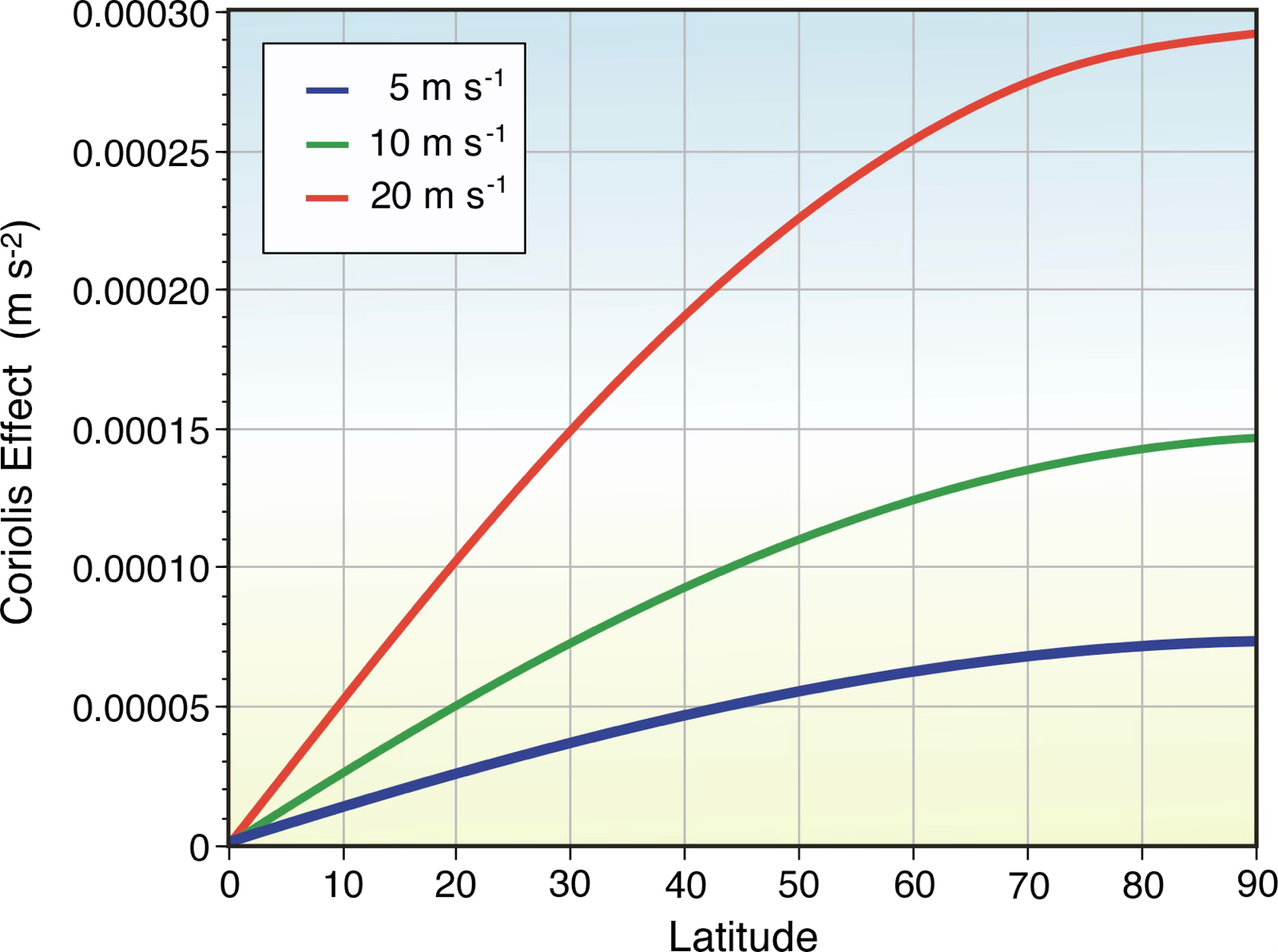

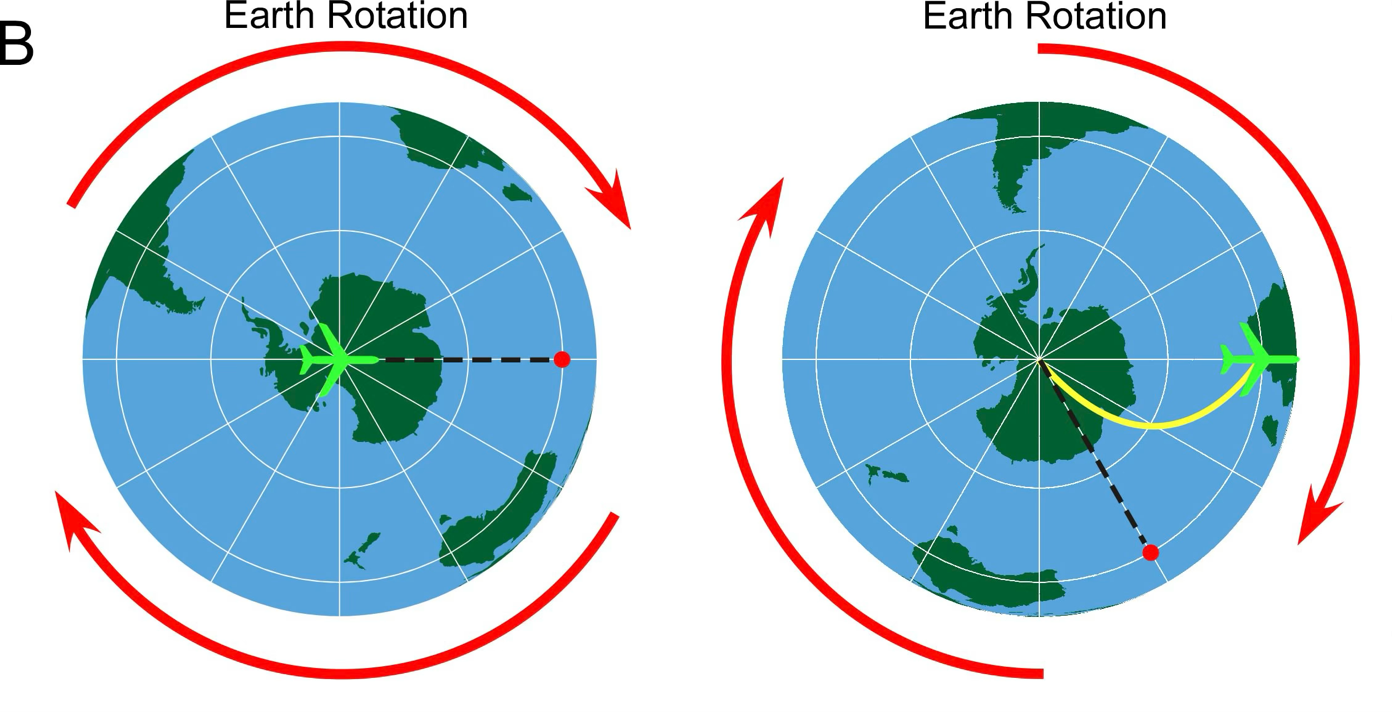

FIGURE 7.14 Association between wind speed and distance between isobars. In the illustration above, thicker arrows represent relatively faster winds. Image Copyright: Michael Pidwirny.
FIGURE 7.16 The apparent deflection due to the Coriolis effect differs in the North and South Hemispheres. Note that the Coriolis effect does not occur on the Equator. In the Northern Hemisphere, objects are deflected to the right, while in the Southern Hemisphere, they are deflected to the left. The solid black lines represent the actual route a moving object takes under the influence of the Coriolis effect. The dashed yellow lines represent the intended path. Image Copyright: Michael Pidwirny.
FIGURE 7.17 The strength of the Coriolis effect is influenced by latitude and the speed of the moving object. This graph shows three objects traveling at 5, 10, and 20 meters per second. Image Copyright: Michael Pidwirny.
FIGURE 7.18 Influence of Coriolis effect on moving objects above the Earth’s surface. From a perspective above the North Pole, the airplane’s path is deflected to the right (A). Above the South Pole, the aircraft is deflected to the left (B) from its intended path. IllustrationCshows how this deviation increases with latitude. Note: at the equator, the Coriolis effect is effectively zero. Image Copyright: Michael Pidwirny.