Earth Rotation and Revolution
The term Earth rotation refers to the spinning of our planet on its axis. Because of rotation, the Earth's surface moves at the equator at a speed of about 467 m (1532 ft) per second, or slightly over 1675 km (1040 mi) per hour. If you could look down at the Earth's North Pole from space, you would notice that the direction of rotation is counterclockwise (Figure 4.15). The opposite is true if you view the Earth from the South Pole. One rotation takes exactly twenty-four hours and is called a mean solar day. The Earth's rotation is responsible for the daily cycles of day and night. At any moment, one-half of the Earth is in sunlight, while the other half is in darkness. The edge dividing the daylight from the night is called the circle of illumination (see Figure 4.18). The Earth's rotation also creates the Sun's apparent movement across our sky (Figure 4.16).
The orbit of the Earth around the Sun is called Earth revolution. This celestial motion takes 365.25 days to complete one cycle. Further, Earth's orbit around the Sun is not circular but elliptical (Figure 4.17). An elliptical orbit causes the Earth's distance from the Sun to vary annually. Yet, this phenomenon is not responsible for the Earth's seasons! This variation in the distance from the Sun causes the amount of solar radiation the Earth receives to vary by about 6% each year. Figure 4.17 illustrates the positions in the Earth's revolution where it is closest and farthest from the Sun. On January 3, Perihelion, the Earth is closest to the Sun (147.3 million km or 91.5 million mi). The Earth is farthest from the Sun on July 4, or Aphelion (152.1 million km or 94.5 million mi). The Earth's average distance from the Sun over one year is about 149.6 million km (93.0 million mi).
Tilt of the Earth's Axis
The ecliptic plane can be defined as a two-dimensional flat surface that geometrically intersects the Earth's orbital path around the Sun. On this plane, the Earth's axis is not at right angles to this surface but inclined at an angle of about 23.5° from the perpendicular. Figure 4.18 shows a side view of the Earth in its orbit about the Sun on four critical dates: June solstice, September equinox, December solstice, and March equinox. As seen from space, the angle of the Earth's axis in relation to the ecliptic plane and the North Star on these four dates would remain unchanged. Yet, the relative position of the Earth's axis to the Sun does change during this cycle. This circumstance is responsible for the annual changes in the height of the Sun above the horizon. It also causes the seasons by controlling the intensity and duration of sunlight reaching different locations on Earth. Figure 4.19 shows an overhead view of this phenomenon. In this view, we can see how the circle of illumination shifts across the Earth's surface. During the two equinoxes, the circle of illumination cuts through the North Pole and the South Pole. On the June solstice, the circle of illumination is tangent to the Arctic Circle (66.5°N), and the region above this latitude receives 24 hours of daylight. The Arctic Circle is in 24 hours of darkness during the December solstice.
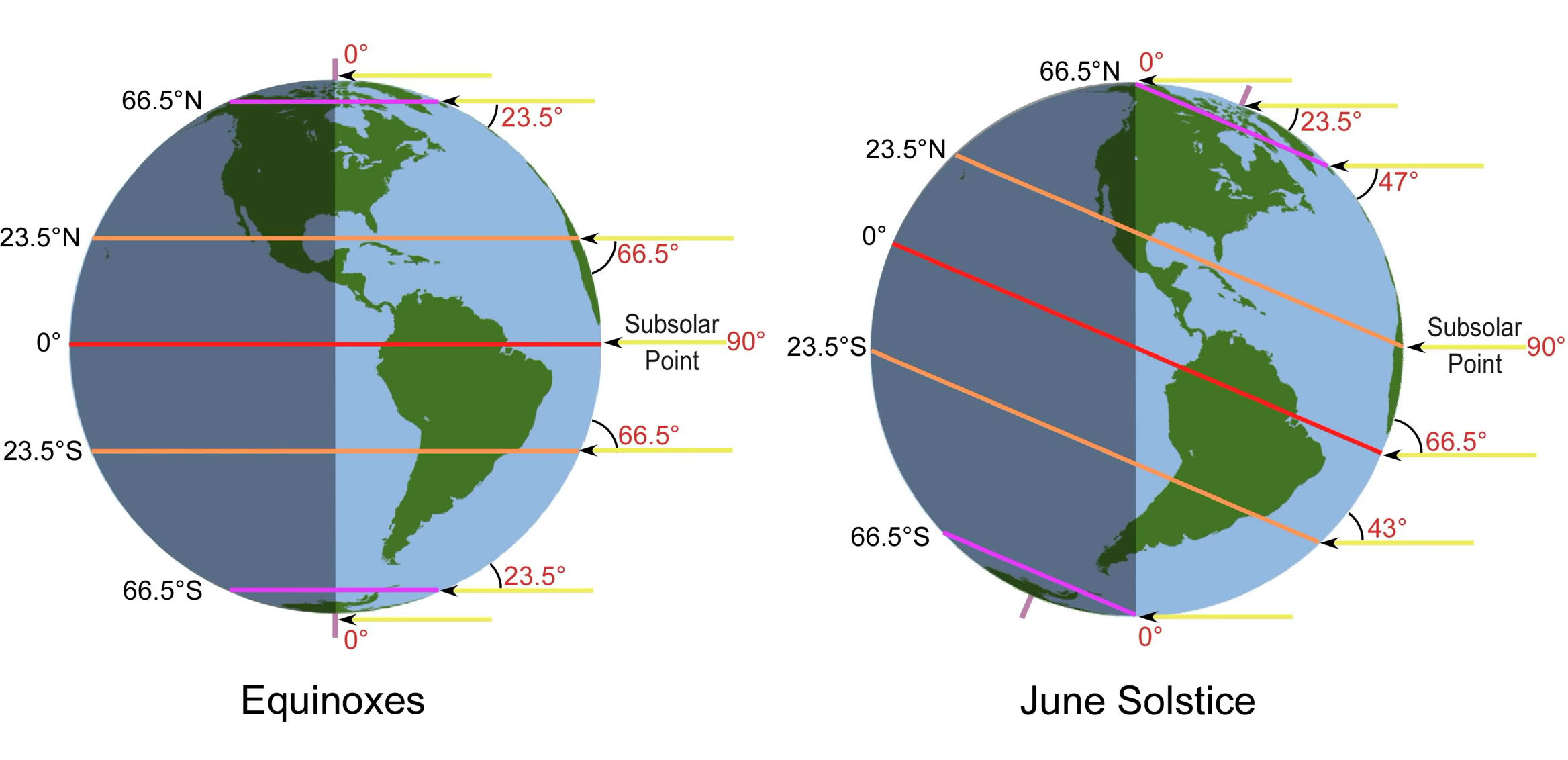
On June 21 or 22, also called the summer solstice in the Northern Hemisphere, the Earth is positioned in its orbit so that the North Pole is leaning 23.5° toward the Sun (Figures 4.18, 4.19, and 4.20). During the June solstice, all locations north of the equator have day lengths greater than twelve hours, while all locations south of the equator have day lengths less than twelve hours (Table 4.3). On December 21 or 22, also called the winter solstice in the Northern Hemisphere, the Earth is positioned so that the South Pole is leaning 23.5 degrees toward the Sun (Figures 4.18, 4.19, and 4.20). During the December solstice, all locations north of the equator have day lengths less than twelve hours, while all locations south of the equator have day lengths exceeding twelve hours (Table 4.3).
On September 22 or 23, also called the autumnal equinox in the Northern Hemisphere, neither pole is tilted toward or away from the Sun (Figures 4.18, 4.19, and 4.21). In the Northern Hemisphere, March 20 or 21 marks the arrival of the vernal equinox or spring, when again, the poles are not tilted toward or away from the Sun. Day lengths on both of these days, regardless of latitude, are exactly 12 hours.
Axis Tilt and Solar Altitude
The annual change in the relative position of the Earth's axis in relationship to the Sun causes the height of the Sun or solar altitude to vary in our skies. Solar altitude is typically measured from the southern or northern horizon and is 0° at the horizon. The maximum solar altitude occurs when the Sun is directly overhead and equals 90°. The total variation in maximum solar altitude for any location on the Earth over one year is 47° (Earth's tilt 23.5° x 2 = 47°). This variation is due to the annual changes in the Earth's relative position to the Sun.
Figure 4.22 shows the changes in solar altitude for locations at the North Pole, 50°N, and the equator for the equinoxes and two solstices. In all of these diagrams, the Sun reaches its maximum altitude at a time described as solar noon. At 50°N latitude, the maximum solar altitude varies from 63.5° on the June solstice to 16.5° on the December solstice. During the equinoxes, the height of the Sun for this mid-latitude location reaches a maximum of 40°. Maximum solar height for the equator goes from 66.5° above the northern end of the horizon during the June solstice to directly overhead (90°) on the fall and spring equinoxes, and then down to 66.5° above the southern end of the horizon during the winter solstice. At the North Pole, the Sun reaches its highest altitude (23.5° above the horizon) during the June solstice. Also, note that the Sun does not rise or set on this day. The Sun makes a complete revolution around the sky at a fixed height, and solar noon technically occurs all day long. On the equinoxes, the sphere of the Sun appears halfway above the horizon. Again, it does not rise or set; it just moves entirely around the horizon in 24 hours. The North Pole is halfway through six months of total darkness during the December solstice. If we could see the Sun through the Earth's surface, it would be 23.5° below the horizon.
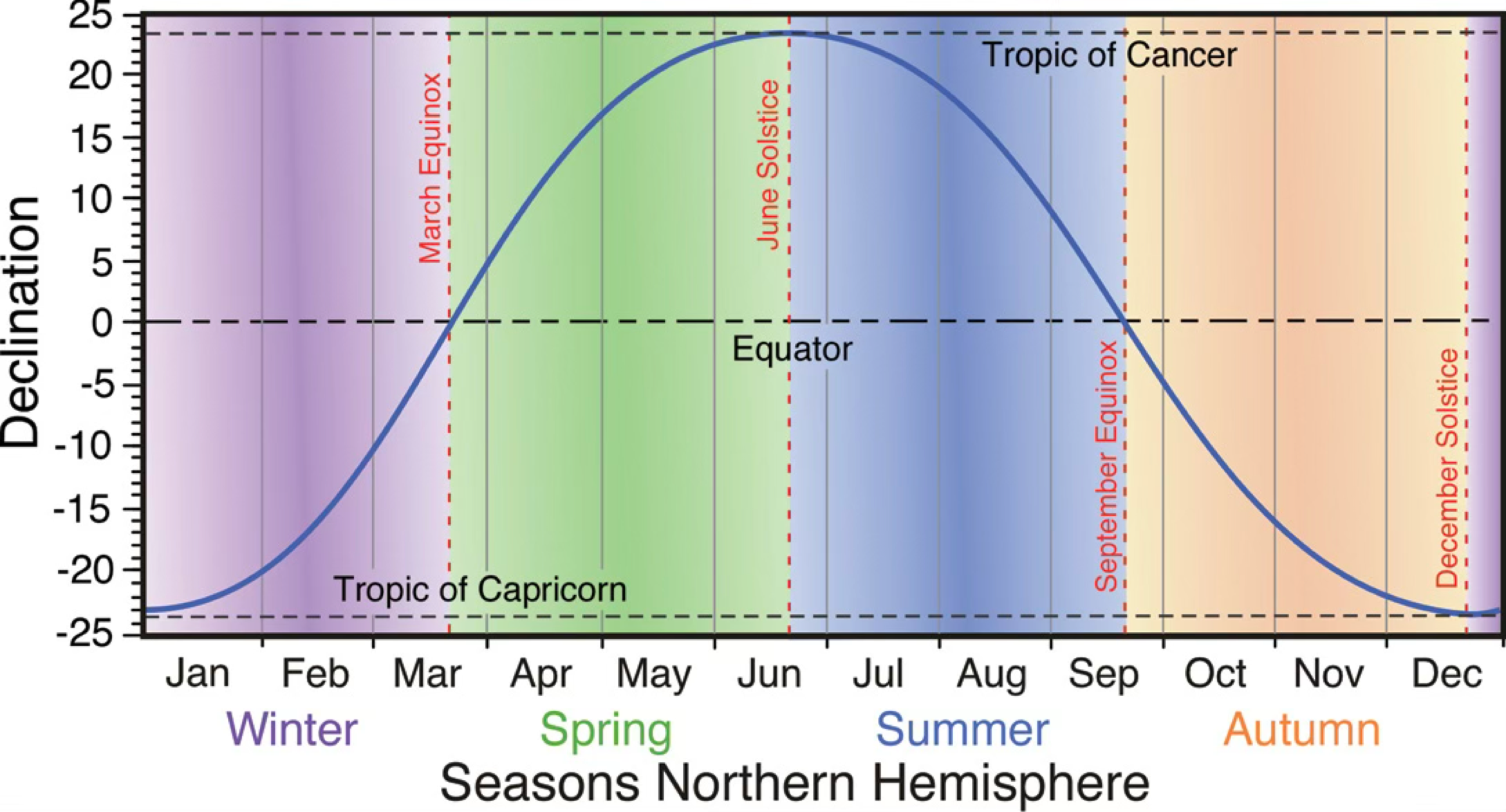
The location on the Earth where the Sun is directly overhead at solar noon is known as the subsolar point. The subsolar point occurs on the equator during the equinoxes (Figure 4.23). On these dates, the Earth's axis is perpendicular to the ecliptic plane, and the poles are not tilted away from or towards the Sun (Figure 4.21). During the June solstice, the subsolar point moves to the Tropic of Cancer (23.5°N) because, at this time, the North Pole is tilted 23.5° toward the Sun (Figure 4.20). Figure 4.24 shows how the subsolar point gradually changes from one day to the next over the course of a year. Note that on this graph, the subsolar point is located at the Tropic of Capricorn (23.5°S) during the December solstice when the South Pole is angled 23.5° toward the Sun (Figure 4.20).
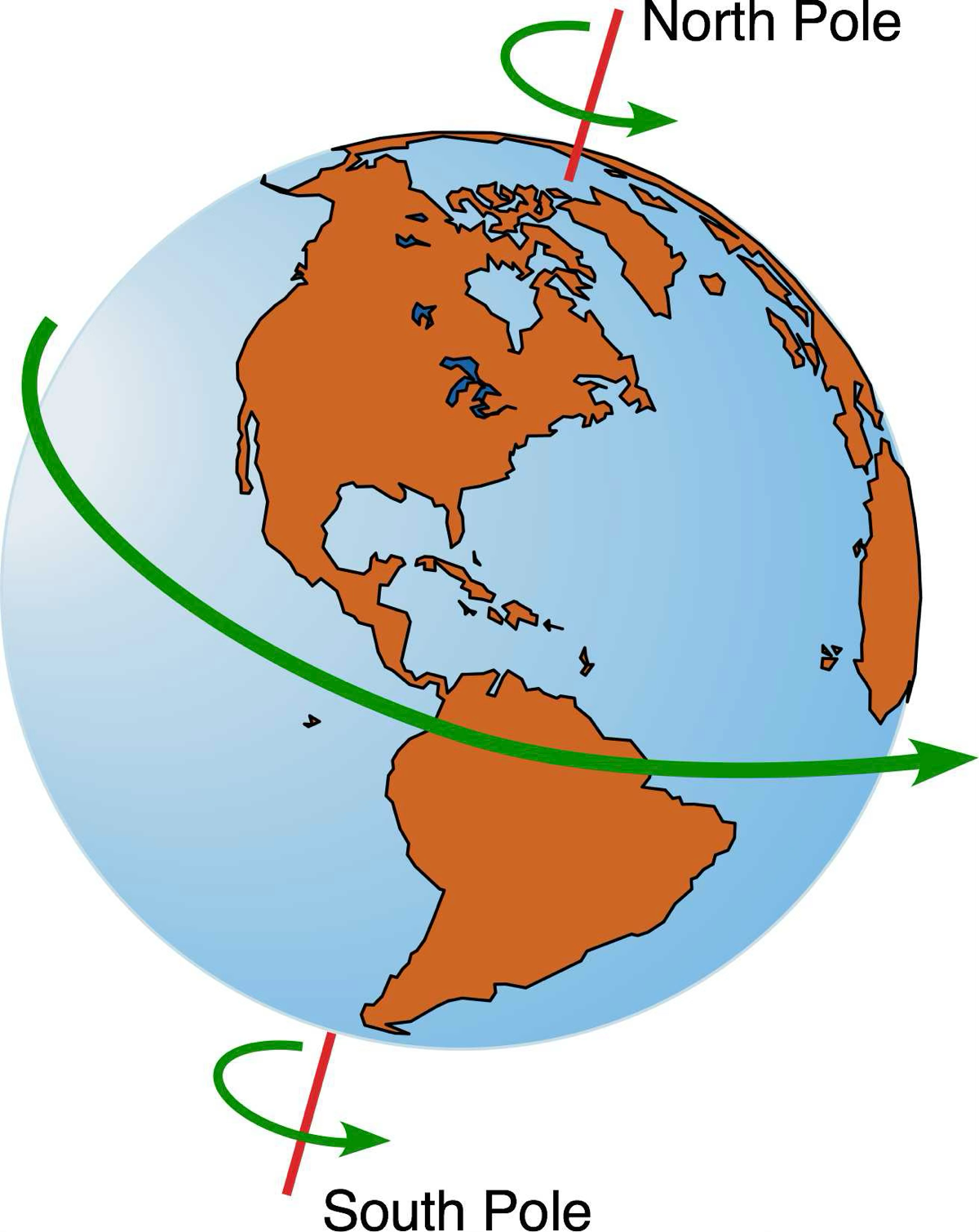
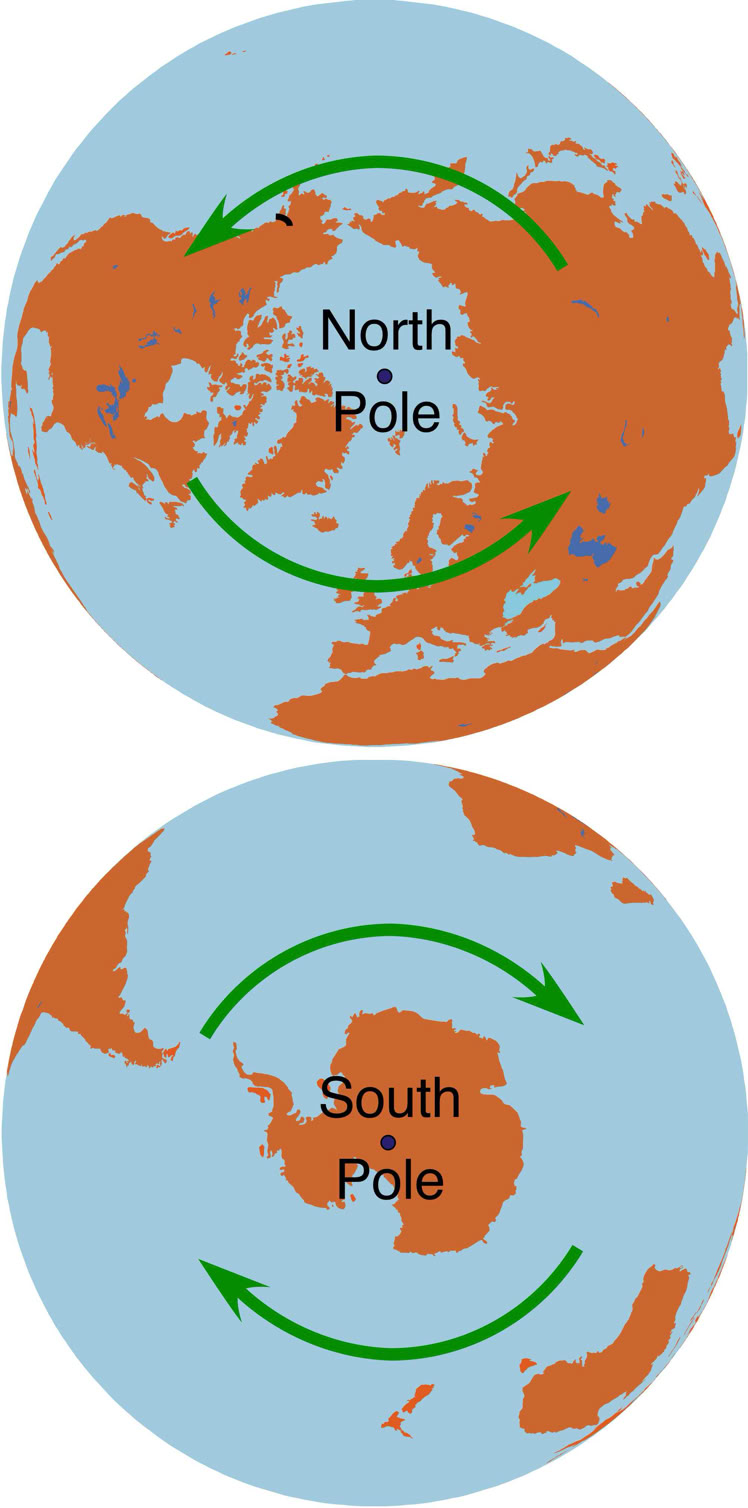
FIGURE 4.15 The movement of the Earth around its axis is known as Earth rotation. The direction of this movement varies with the viewer’s position. From the North Pole, the rotation appears to move counterclockwise. Looking down at the South Pole, the Earth’s rotation appears clockwise. Image Copyright: Michael Pidwirny.
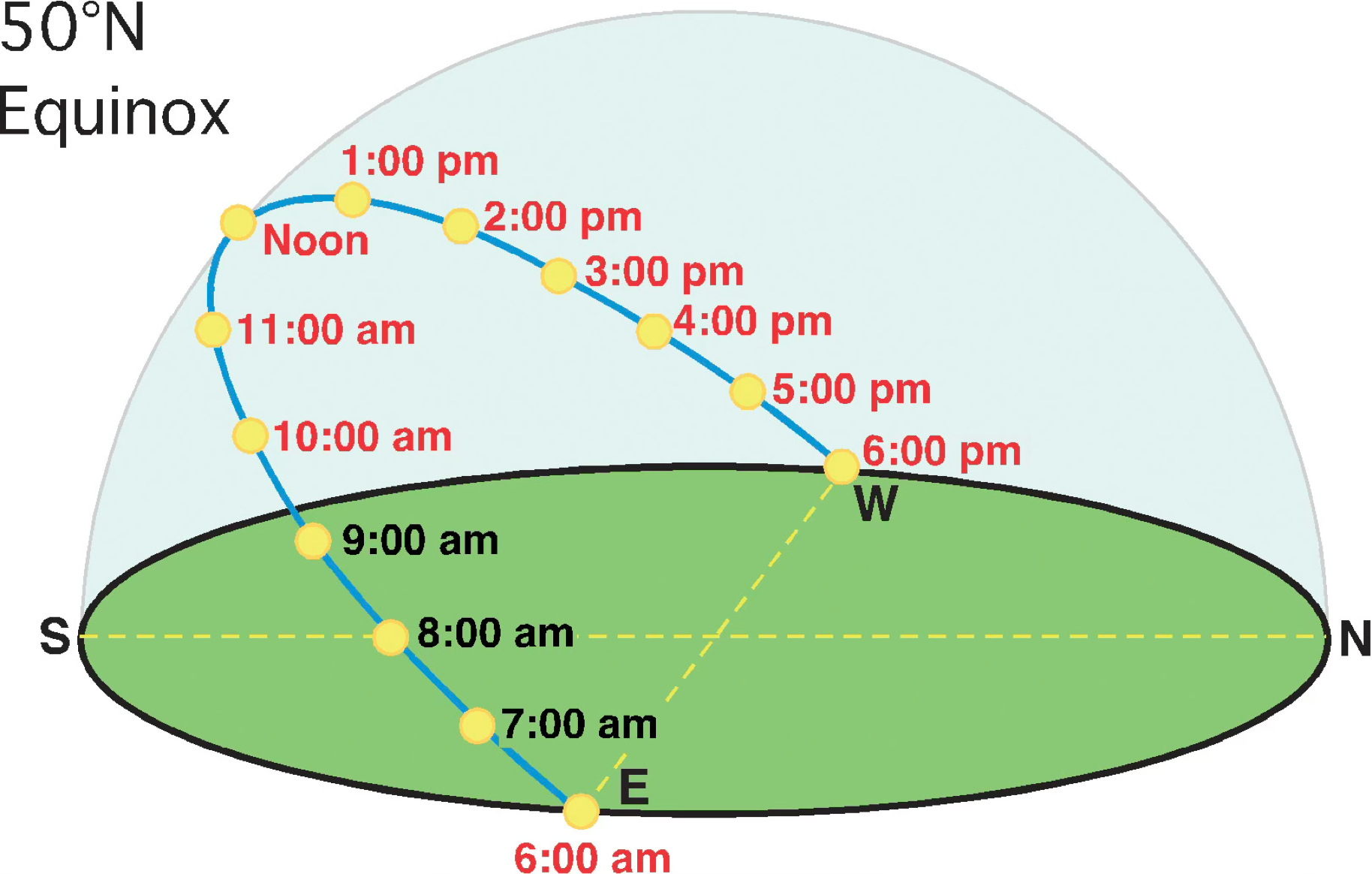
FIGURE 4.16 The apparent daily movement of the Sun across the sky is caused by the rotation of the Earth on its axis during the equinox. Image Copyright: Michael Pidwirny.
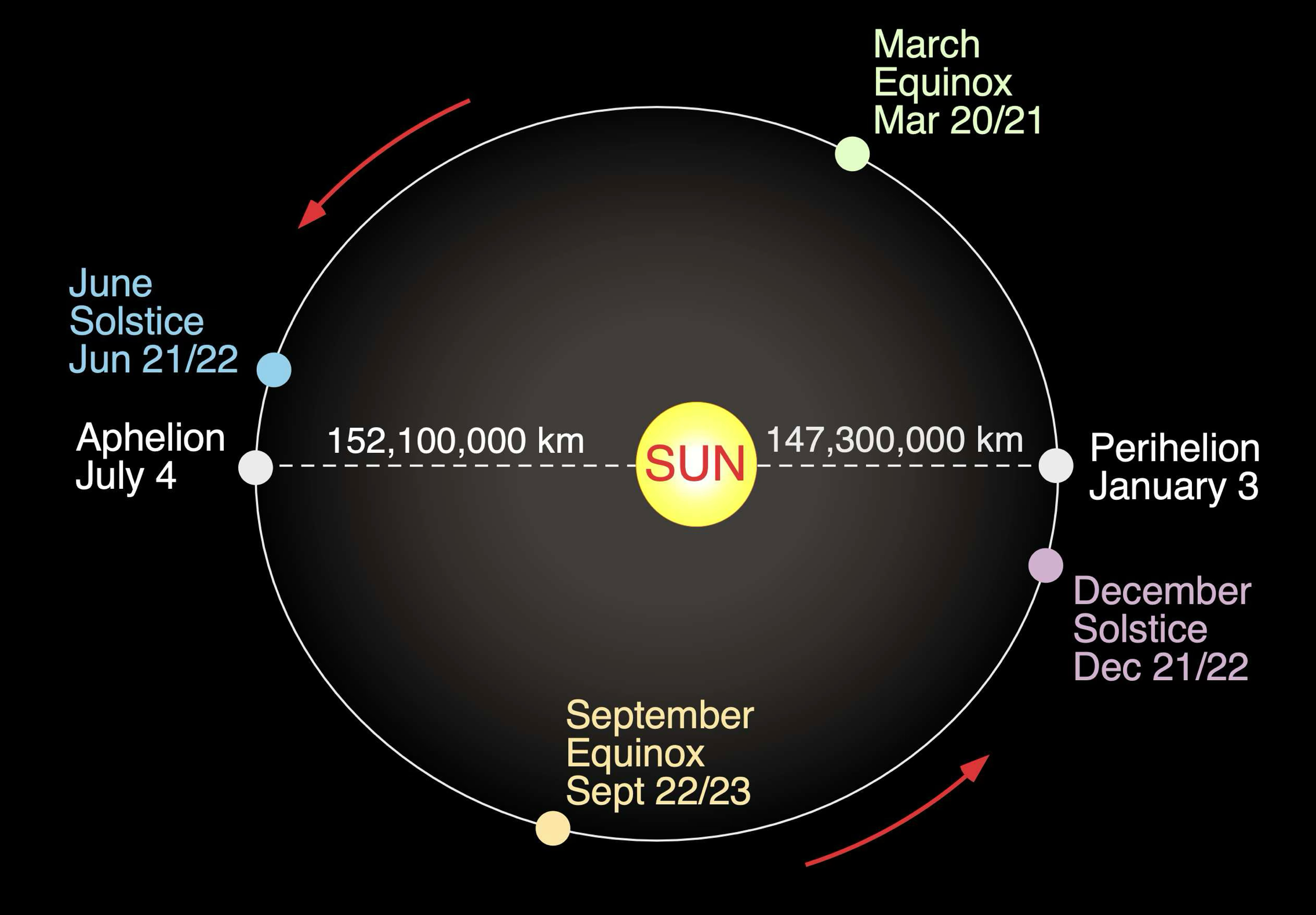
FIGURE 4.17 Earth’s orbit around the Sun. Note the position of the equinoxes, solstices, Aphelion, and Perihelion relative to the Earth's orbit around the Sun. Image Copyright: Michael Pidwirny.
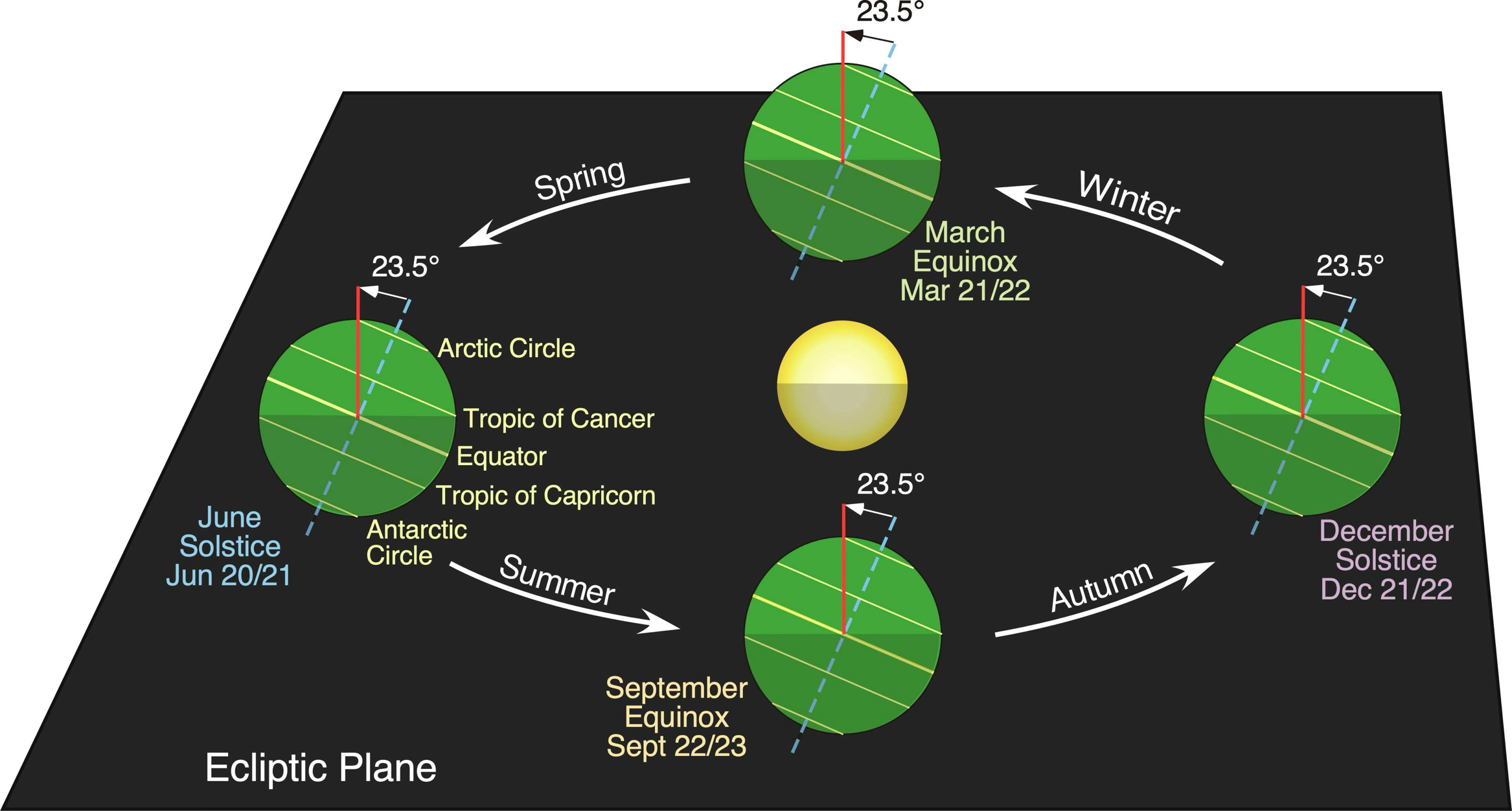
FIGURE 4.18 Earth’s rotational axis and the ecliptic plane. The Earth’s rotational axis is tilted 23.5° from the red line drawn perpendicular to the ecliptic plane. This tilt remains the same anywhere along the Earth’s orbit around the Sun. Image Copyright: Michael Pidwirny.
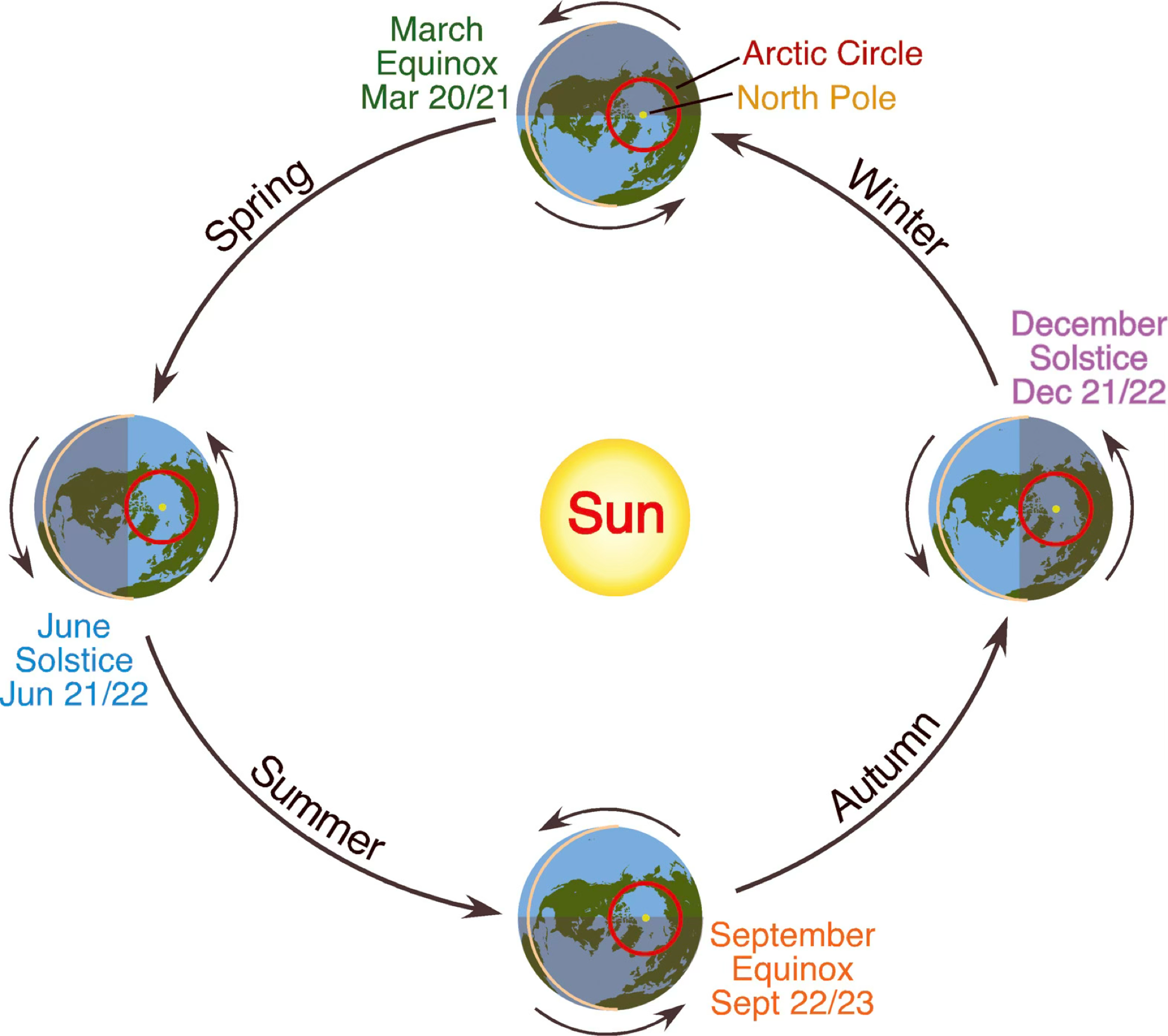
FIGURE 4.19 Annual change in the position of the Earth in its revolution around the Sun. In this graphic, we view the Earth from a point above the North Pole (yellow dot) at the June solstice, the December solstice, and the two equinoxes. Note how the position of the North Pole on the Earth's surface does not change. However, its position relative to the Sun in space does change, and this shift is responsible for the seasons. The red circle on each Earth represents the Arctic Circle (66.5°N). During the June solstice, the area above the Arctic Circle experiences 24 hours of daylight because the North Pole is tilted 23.5° toward the Sun. The Arctic Circle experiences 24 hours of night when the North Pole is tilted 23.5° away from the Sun on the December solstice. At the two equinoxes, the circle of illumination passes through the poles, and all locations on Earth experience 12 hours of day and night. Image Copyright: Michael Pidwirny.
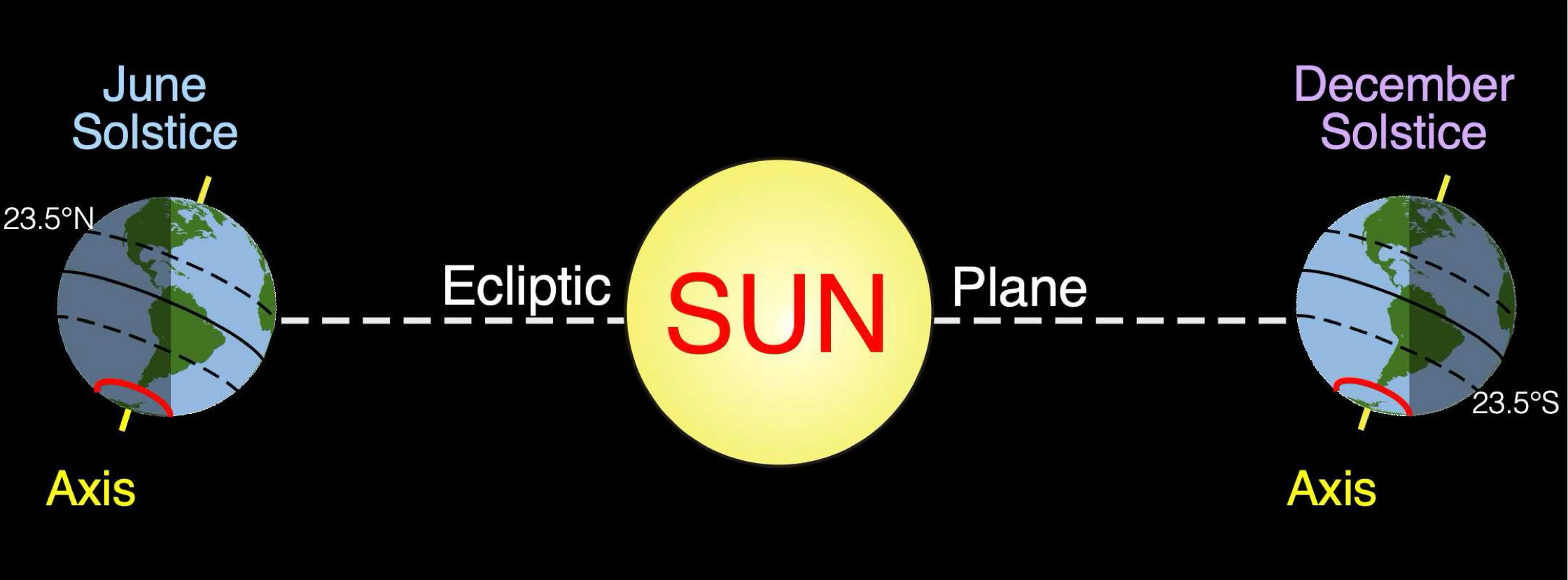
FIGURE 4.20 During the June solstice, the Earth's North Pole is tilted 23.5° towards the Sun relative to the circle of illumination. This fact means that all places above a latitude of 66.5°N receive 24 hours of sunlight (summer), while locations below a latitude of 66.5°S are in total darkness (winter). The North Pole is tilted 23.5° away from the Sun at the December solstice. On this date, all places above a latitude of 66.5°N are now in darkness (winter), while locations below a latitude of 66.5°S receive 24 hours of daylight (summer). The red circles shown in the graphic are the Antarctic Circle. Image Copyright: Michael Pidwirny.
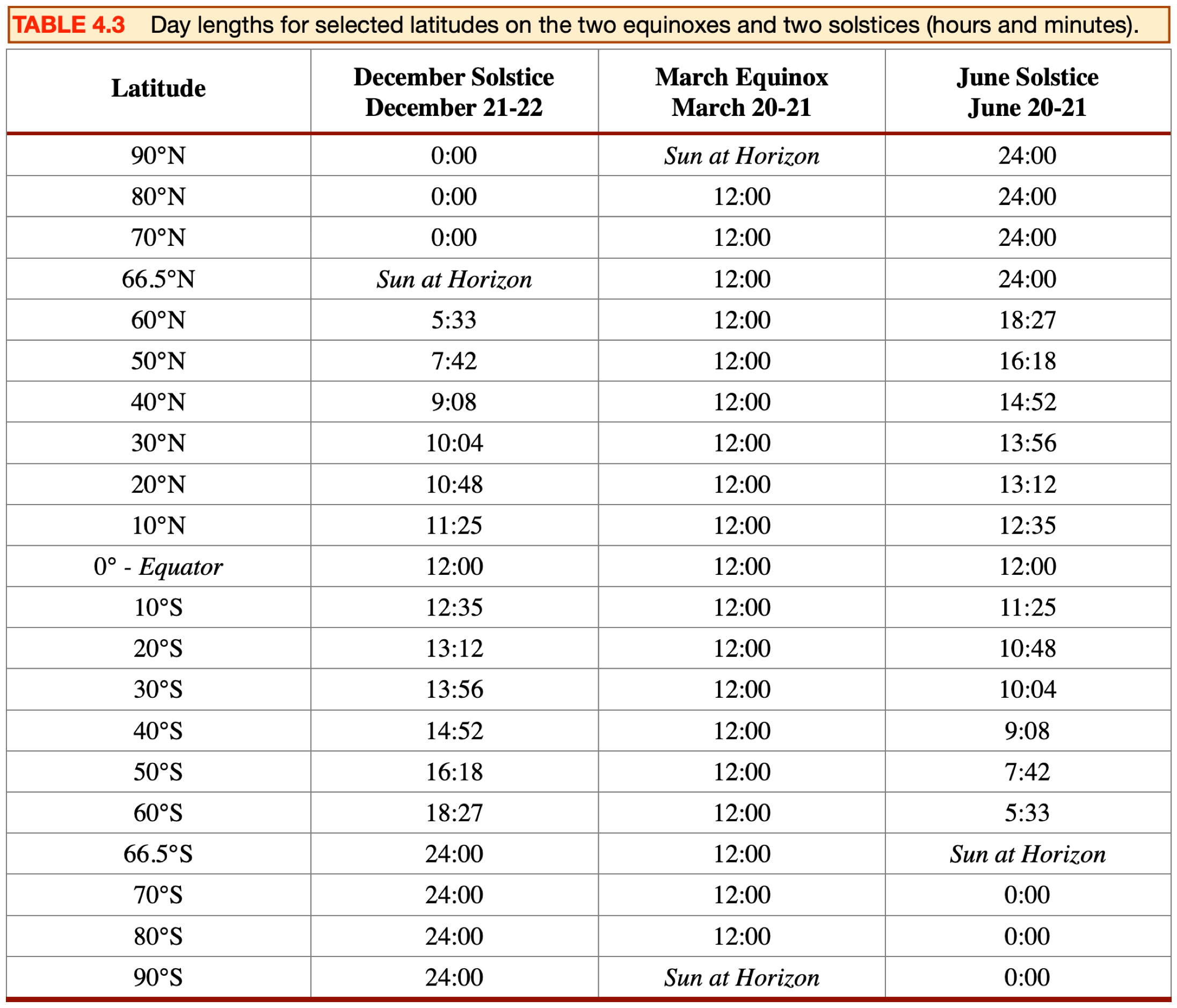
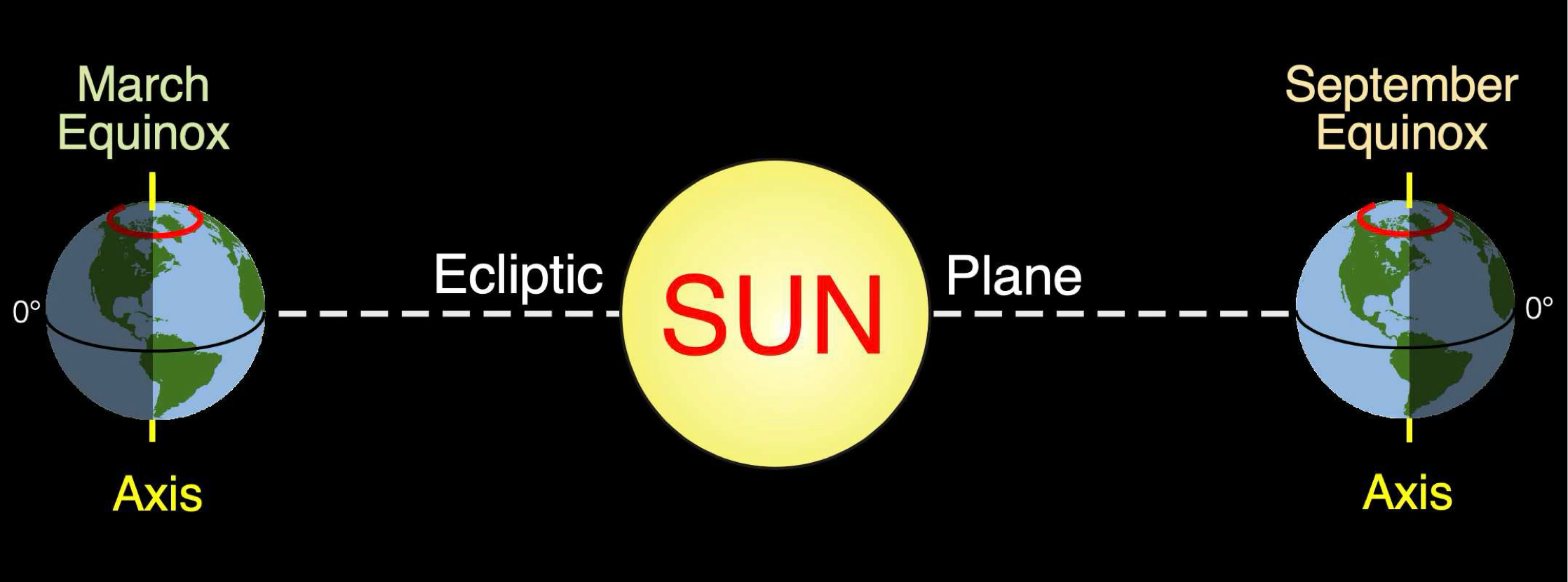
Figure 4.21 During the equinoxes, the axis of the Earth is not tilted toward or away from the Sun, and the circle of illumination cuts through the poles. This situation does not mean that the Earth's 23.5° tilt no longer exists. The vantage point of this graphic shows that the Earth's axis is inclined 23.5° toward the viewer for both dates (see Figures 5 and 6). The red circles shown in the graphic are the Arctic Circle. Image Copyright: Michael Pidwirny.
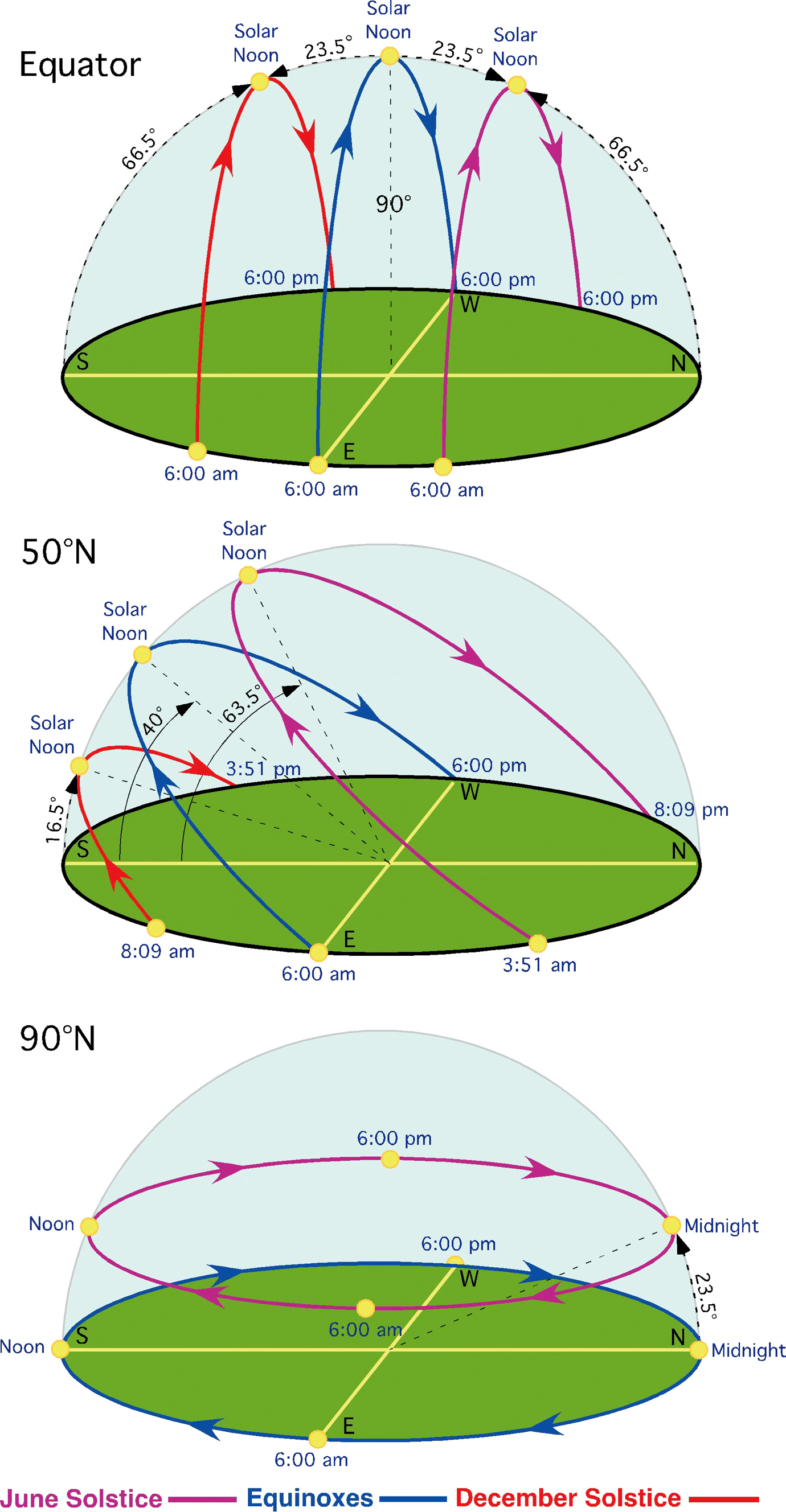
FIGURE 4.22 Daily solar paths for different times of the year at the equator, 50°N, and 90°N. Notice that the equator experiences 12 hours of daylight for the four dates shown. At 50°N, day length is longest during the June solstice and shortest during the December solstice. The North Pole (90°N) experiences 24 hours of daylight during the June solstice and 24 hours of night on the December solstice. During the equinoxes, the Sun is halfway above the horizon all day. Image Copyright: Michael Pidwirny.