FIGURE 12.26 This image shows an area of forest in the Pearl River Basin, which extends from central Mississippi to the Louisiana border. In Mississippi, more than 1.3 million acres of natural forest were significantly damaged by Hurricane Katrina in 2005. The Mississippi Forestry Commission estimated this resulted in an economic loss of 1.3 billion US dollars. About 2.7 million trees were also found to be damaged in Mississippi’s urban areas. Urban tree damage was estimated at 1.1 billion US dollars. Modified Image Source: NASA, Earth Observatory.
Most biogeographers and ecologists at the turn of the 20th century believed that ecosystems were an example of systems that were normally in a state of stable equilibrium. A closer investigation of this idea revealed that the stable equilibrium condition was rarely achieved due to the frequency of disturbance events. As mentioned previously in this chapter, a disturbance is any process that disrupts an ecosystem, community, or species population by changing resource availability, biotic interactions, or physical conditions.
Some common disturbance mechanisms include fire, wind, flooding, landslides, volcanic eruptions, logging, climate change, old-age mortality, herbivory, predation, disease, and pest infestation. These mechanisms operate under specific spatial and temporal scales due to various factors. The preceding discussion will examine a few of these disturbance mechanisms in greater detail.
Fire
Fire is probably the most studied mechanism of disturbance. We pay much attention to this process because wildfires often destroy many economically important plant species. In Canada's Coniferous and Boreal Forests, about 10,000 wildfires occur on average every year. Annually, these fires consume about 2 million hectares (4.94 million acres), or 0.6% of the total forested area in this country (Figure 12.24). Wildfires are also common in other types of ecosystems worldwide, including grasslands, savannas, chaparral, xeric shrublands and woodlands, and subtropical coniferous forests.
Fire can occur in any ecosystem if the conditions are right. The basic requirements for fire include fuel material and a source of ignition. Fuel material consists of live vegetation and litter located on the soil surface. The ability of this fuel to ignite and burn is controlled by factors such as prevailing weather, topography, and vegetation type. Fires are usually more frequent and severe after a prolonged drought.
In many ecosystems, lightning is the most significant source of ignition. People who set fires in ecosystems intentionally or accidentally also start many wildfires. Of course, human-caused fires have a different spatial distribution than lightning-caused fires. Human-caused wildfires are more likely to occur near human settlements or along surface transportation routes. Lightning-produced fires tend to be, on average, much larger than human-caused fires. This is because lightning-caused fires often occur in areas inaccessible to firefighters. As a result, these fires grow almost unrestrained.
Wildfires occur across a wide range of temporal and spatial scales. The reason for this variation is complex, involving factors such as fuel conditions, weather, and topography. Wildfires in tropical rainforest ecosystems are commonly limited to a single tree because conditions are generally very damp, making it hard for fires to spread. At the other end of the spatial scale, fires in Canadian Coniferous and Boreal forests can occasionally exceed 100,000 hectares (250,000 acres) in size. With strong winds, these fires can often move several kilometers (miles) in a matter of hours. The main factor responsible for the large fires found in coniferous and Boreal Forests is long-term drought over extensive areas.
Wildfires also show significant temporal variation. In the cold, moist Tundra, vegetation rarely ignites or burns. Return rates for fires in Tundra vegetation are probably less than once in 1000 years. Fires in the Temperate Deciduous Forest of the eastern United States occur with a chance less than once every 300 years. In grasslands, savannas, and drier pine forests, fire return frequency can be as short as once every one to five years.
Fires play an important role in controlling the geographic distribution of some species. Vegetation in areas that experience frequent fires often have adaptations that allow them to tolerate the stress associated with this type of disturbance. Some trees, like Ponderosa Pine (Pinus ponderosa) and Douglas Fir (Pseudotsuga menziesii), have a thick fire-resistant bark that protects living tissues from the damaging effects of fire. Most grasses and forbs on the Prairies produce their above-ground stems and leaves from budding tissue beneath the soil surface. This adaptation keeps this vital growth tissue protected from surface fires. Fire plays an essential role in seed dispersal and germination for some plants. The seed cones of certain pine trees are sealed with a resin that only melts when burned. Once melted, the cones pop open, releasing the seeds accumulated over many years of cone production into the newly disturbed environment.
Humans have altered the fire return cycle in many ecosystems. Fires are being suppressed in these ecosystems to protect economically valuable species, support livestock grazing, and safeguard people and property. The dry regions of California are home to forests, woodlands, and shrublands that burn naturally on very frequent cycles (Figure 12.25). Because of this state's high population density, these fires are actively being controlled. Research in southern Arizona has documented the invasion of pine and oak forests into semiarid grasslands. Before fire suppression, fires burned in the semiarid grasslands every 4 to 8 years. This cycle was frequent enough to curb the establishment of pine and oak and promote grassland species. In the northern Prairies of Canada, the reduced frequency of fires has led to an invasion of poplar and spruce trees. Resource managers have now recognized these consequences and instituted prescribed burns across many ecosystems.
Wind
Next to fire, wind is the most common and widespread mechanism of disturbance. The effect of wind is most apparent on rooted, immobile organisms, such as trees in a forest. Windthrow damage in forest ecosystems can range from a few branches on a single tree to a swath of hundreds or thousands of downed trees. Large-scale wind disturbances are often caused by powerful storms, such as mid-latitude cyclones, hurricanes, and severe thunderstorms. Hurricanes and thunderstorms generated microbursts and tornadoes are probably the most destructive of these weather events because of their intense winds. Winds in these weather phenomena can often exceed 200 kilometers per hour (124 miles per hour).
Windthrow damage due to hurricanes tends to be concentrated in the tropics and subtropics (see Chapter 8, section Tropical Weather and Hurricanes, Figures 8.36 and 8.37). Even within this geographic region, hurricanes rarely affect some areas, while others are frequently affected. In the tropics and subtropics, the eastern coasts of continents are generally more prone to hurricanes than the western coasts. Destructive hurricane winds often affect the region around the Gulf of Mexico (Figure 12.26). For example, researchers have found that about 80% of Puerto Rico's forests have been disturbed by hurricanes over the last 100 years. In August 1992, Hurricane Andrew ripped a 20-kilometer-wide (12-mile-wide) swath of damage through southern Florida. The total area affected by this hurricane was approximately 1600 square kilometers (618 square miles). The disturbance associated with hurricanes can occasionally extend into the mid-latitudes. In 1938, 2530 square kilometers (977 square miles) of forest were damaged in New England.
Thunderstorm microbursts and tornadoes typically influence relatively small areas. Despite their small size, both phenomena occur pretty frequently in the eastern half of the United States and adjacent Canada. The destruction associated with tornadoes tends to be long, narrow, and irregular. Microburst wind speeds can approach 400 kilometers per hour (250 mph), and the damage tends to be linear. Like hurricanes, these disturbance mechanisms have particular geographic distributions (see Chapter 8, section Thunderstorms, Figures 8.5, 8.9, and 8.14).
Finally, not all wind disturbances are caused by severe weather phenomena. Most forests contain many small disturbance gaps caused when relatively light winds blow over old or dead trees. Often, the falling dead tree can take down other live vegetation.
Flooding and Inundation
Low-lying areas adjacent to streams, lakes, and ocean shorelines are often disturbed by fluctuations in water levels due to floods or changes in precipitation and drainage (Figure 12.27). Flooding in rivers and lakes is usually associated with heavy precipitation and/or rapid snowmelt. Coastline flooding is generally linked to high winds and/or storm surges from hurricanes. The characteristics of a flood can vary significantly in terms of timing, intensity, and frequency.
The effects of flooding on organisms are highly variable. Species in areas where flooding is a common occurrence often have adaptations to withstand this stress.


FIGURE 12.25 Some fire managers and scientists have suggested that fire suppression activities in California’s forests, woodlands, and scrub plant communities have altered the characteristics of natural wildfires. These activities are believed to be causing vegetation fires to have much larger spatial extents. The following image was taken from the International Space Station on October 26, 2003, and shows wildfires burning out of control in the San Bernardino Mountains of California. Image Source: NASA.

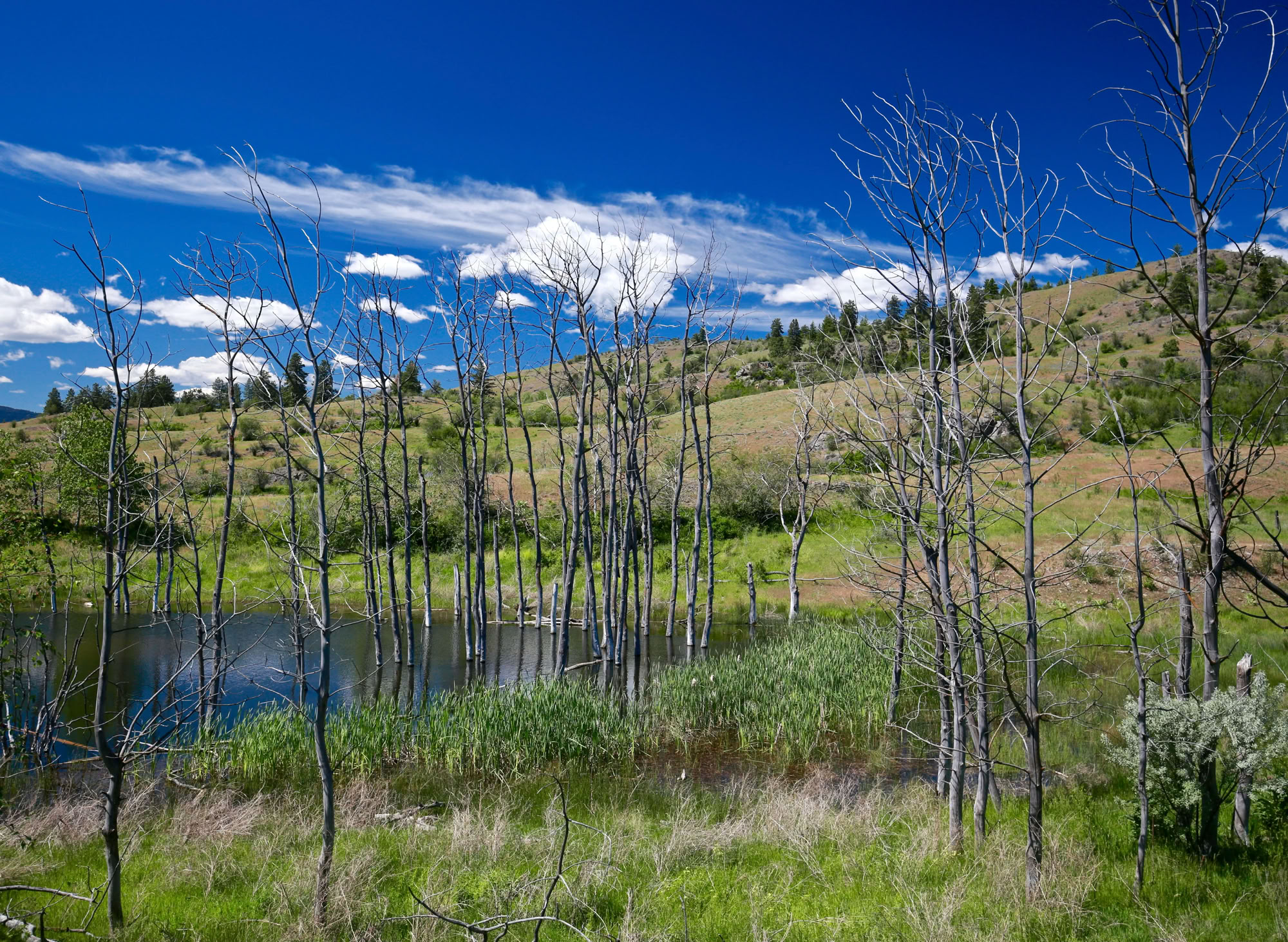
FIGURE 12.27 Vegetation found growing around flood-prone areas can usually survive inundation for short periods. However, these trees perished because the site where they grew remained inundated for an extended period due to changes in precipitation patterns. Image Copyright: Michael Pidwirny.
FIGURE 12.24 Several large fires were burning across southern British Columbia, Canada, during August 2003 (fire sites are colored red). Three consecutive years of drought create ideal conditions for this type of disturbance in forest and grassland ecosystems. This image was captured on August 23 by the Moderate Resolution Imaging Spectroradiometer (MODIS) on NASA’s Aqua satellite. Image Source: NASA.