In the next five chapters, we will focus on the Earth's biosphere. The biosphere is unique from the other three spheres that we have already studied. This uniqueness stems from the fact that the biosphere is composed of many different types of living things. Scientists estimate that these different living things or species may number in the tens of millions. Life also displays some interesting properties not found in the various abiotic (nonliving) parts of the lithosphere, hydrosphere, and atmosphere. For example, living things can evolve through time. Over Earth's long history, evolution may have created more than 100 million species. Each of these species was uniquely adapted to its environment. Most of these species have now gone extinct. Evidence of the past existence of these organisms is clearly documented in fossils.
Life can be found all over our planet. Life survives in environments ranging from the bitterly cold ice fields of Antarctica to the hot, dry climates of subtropical deserts. Some organisms even have adaptations that allow them to live in the near-boiling waters of hot springs, while others are at home on the ocean floor, more than 4000 meters (13,100 ft) below sea level. Yet, no single species is capable of living in all of these places. In fact, most species have very specific geographic distributions that only cover several hundred to several thousand square kilometers (miles).
In this section, we will begin our investigation of the factors responsible for the geographic distribution of life on our planet, both past and present. This field of geographic science is commonly known as biogeography. Biogeography is a very broad discipline. It incorporates knowledge common to biology, ecology, botany, zoology, geography, and geology.
What is Life?
The best place to begin our discussion of the Earth’s biogeography is to answer the following question. What is life? While the answer to this question may seem simple, scientists have spent considerable time pondering it. Many scientists would suggest that we still do not have a clear, definitive answer to this question. Part of this problem is related to the presence of viruses (Figure 11.1) and other microscopic organisms. Some scientists define a virus as a very complex organic molecule, while others suggest it is the simplest form of life.
In a past issue of the journal Science (Koshland, 2002), molecular biologist Daniel E. Koshland, Jr. was asked to write a special essay in which he would define life. In this article, he suggested that something could be considered “alive” if it meets the following seven conditions.
- Living things require a program to make copies of themselves from generation to generation. This program would describe the parts that make up the organisms and the various processes that function between the various parts. These processes are, of course, the metabolic reactions that enable a living thing to function. In most living systems, the program of life is encoded in a complex organic molecule called DNA (Deoxyribonucleic Acid).
- Life adapts and evolves in step with external environmental changes. This process directly connects to life’s program through mutation and natural selection. This condition allows life forms to adapt to gradual environmental changes.
- Organisms tend to be complex, highly organized, and, most importantly, have compartmentalized structures. Chemicals found within their bodies are synthesized by metabolic processes into structures with specific purposes. Cells and their various organelles are examples of such structures. Cells are also the basic functioning unit of life. In multicellular organisms, cells are often organized into organs to achieve greater complexity and function.
- Living things can take energy from their environment and change it from one form to another. This energy is usually used to facilitate their growth and reproduction. We call the process that allows for this facilitation - metabolism.
- Organisms have regeneration systems that replace parts of themselves that are subject to wear and tear. This regeneration can be partial or involve the complete replacement of the organism. A complete replacement is necessary because partial replacements cannot halt the inevitable decline in the functioning state of the entire living system over time. In other words, all organisms degrade into a final nonfunctioning state we call death.
- Living creatures respond to environmental stimuli through feedback mechanisms. Environmental cues can cause organisms to respond through behavioral, metabolic, and physiological changes. Further, responses to stimuli generally act to increase a creature’s chance for day-to-day survival.
- Organisms can maintain numerous metabolic reactions even in a single moment. Living things also keep many of these reactions separate.
Domains and Kingdoms of Life
Biologists recognize three top-level domains of living organisms: Archaea, Bacteria, and Eukaryota. Archaea are a group of recently discovered organisms adapted to live in extremely hostile habitats. Examples of such hostile habitats include thermal volcanic vents, saline pools, and hot springs (Figure 11.2). These single-celled organisms are pretty similar in appearance to bacteria. However, molecular studies have shown that this group of organisms is biochemically and genetically very different from bacteria.
Bacteria are simple single-celled organisms that generally lack chlorophyll (an exception is cyanobacteria) (Figure 11.3). Bacteria typically obtain energy for survival by breaking down organic matter through fermentation and respiration. Any organism that relies on living or previously living organic matter for food is called aheterotroph. Bacteria such as cyanobacteria and those belonging to the genusRhizobiumplay an essential role in fixing atmospheric nitrogen. Without these organisms, most ecosystems would be scarce of this very important nutrient. Nitrogen is an essential nutrient used by both plants and animals for growth.
Bacteria also have an essential role in decomposing soil organic matter. A single teaspoon of topsoil can contain more than a billion bacteria. The process of decomposition converts organic matter back into essential chemical elements. Once converted, these recycled nutrients can be used again for the growth and metabolism of organisms.
Eukaryota are organisms that have a eukaryotic cell type. This life group includes the four primarykingdoms: Protista, Fungi, Plantae (plants), and Animalia (animals). A kingdom is a classification category, the second broadest after a domain. The kingdomProtistacomprises single-celled organisms and some of their simple multicelled close relatives. Some examples of unicellular protists include dinoflagellates, amoebas, paramecia, diatoms, and volvox (Figure 11.4). Slime molds, brown algae, red algae, and green algae, such as Ulva (sea lettuce), are typical examples of multicellular protists (Figure 11.5).
Researchers estimate that about 1.5 million different species of fungi exist on our planet (Figure 11.6). Most of these life forms are multicelled. Biologists once grouped fungi with plants. However, investigations of this life form indicate that fungi are quite different from other eukaryotes regarding feeding strategies, physiological organization, reproduction, and growth. Many species of fungi are heterotrophic decomposers, or they live in symbiosis with another species. Symbiosis is a biological interaction where two different species are in direct contact with each other. This relationship is also necessary for the survival of one or both participating species. Lichens are an excellent example of this type of biotic relationship. Lichens are a life-form that involves the symbiotic relationship between a fungus and a photosynthetic alga (Figure 11.7).
The kingdom Plantae comprises multicelled organisms that can convert inorganic elements, with the help of the Sun’s energy, into organic compounds. In plants, this process is carried out chemically through photosynthesis. Any life form that can carry out photosynthesis is called an autotroph. An autotroph is any organism that can fix organic molecules from inorganic elements with the help of an external energy source. Autotrophs also consume some of the organic compounds they create to fuel their metabolism, growth, and reproduction.
Plantae includes all land plants, including mosses, ferns, conifers, and flowering plants (Figure 11.8). Diversity in this kingdom is quite large, with more than 250,000 species. Two other essential traits associated with plants are cell walls made of cellulose and a large central cellular vacuole. Cellulose is an extremely strong organic material. Plants use cellulose to create highly sturdy cells and to build structures like stems and tall tree trunks. Another distinguishing feature of plants is the presence of a large central vacuole in their cells. Central vacuoles are used to store water reserves, essential chemicals for growth and metabolism, waste products, toxins, and flower pigments.
Animals are multicellular organisms with eukaryotic cells (Figure 11.9). For food consumption, species in the kingdom Animalia must ingest already-produced organic molecules. Unlike plants, animals are heterotrophs and, therefore, cannot create their own nourishment from inorganic compounds. Animals also differ from other forms of life by having two unique tissue types: Nervous tissue and muscle tissue. Finally, most animals produce their offspring through sexual reproduction rather than asexual reproduction.

FIGURE 11.1 So what exactly are viruses? Viruses are not cells. Viruses are fragments of DNA or RNA that depend on host cells that they infect for their reproduction. Viruses exploit the host cell's metabolic processes to replicate and produce new viruses. Viruses are thought to be parts of the genetic code that originated from either eukaryotic or prokaryotic cells. These code fragments contain enough genetic information for self-existence. At times, viruses are metabolically inert and technically nonliving. Viruses cause a variety of diseases in eukaryotic organisms. In humans, they can cause smallpox, chicken pox, influenza, shingles, herpes, polio, Ebola, AIDS, rabies, and some types of cancer. The image above shows the Marburg virus (Marburg virions) at greatly magnified levels under a microscope. This virus causes hemorrhagic fever. In 1967, thirty-one people in Germany and Yugoslavia became infected with the Malberg virus, and seven died. Image Source: Wikimedia Commons, United States Centers for Disease Control and Prevention (CDC) Public Health Image Library.

FIGURE 11.2 When first discovered in 1977, archaea were considered a unique type of bacteria. However, studies of archaeal cells at the molecular level indicated that these organisms were actually a separate category of life. Archaea very much look like bacteria and have some genes similar to those found in bacteria. Yet they contain other genes more like those found in eukaryotes. Further, they have genes not found in any other organism. It is generally believed that archaea and bacteria developed separately from a common ancestor over 3 billion years ago. The image above shows an electron microscopic view of Halobacterium sp. strain NRC-1. This organism lives in an environment with a high salt concentration. Image Source: NASA.
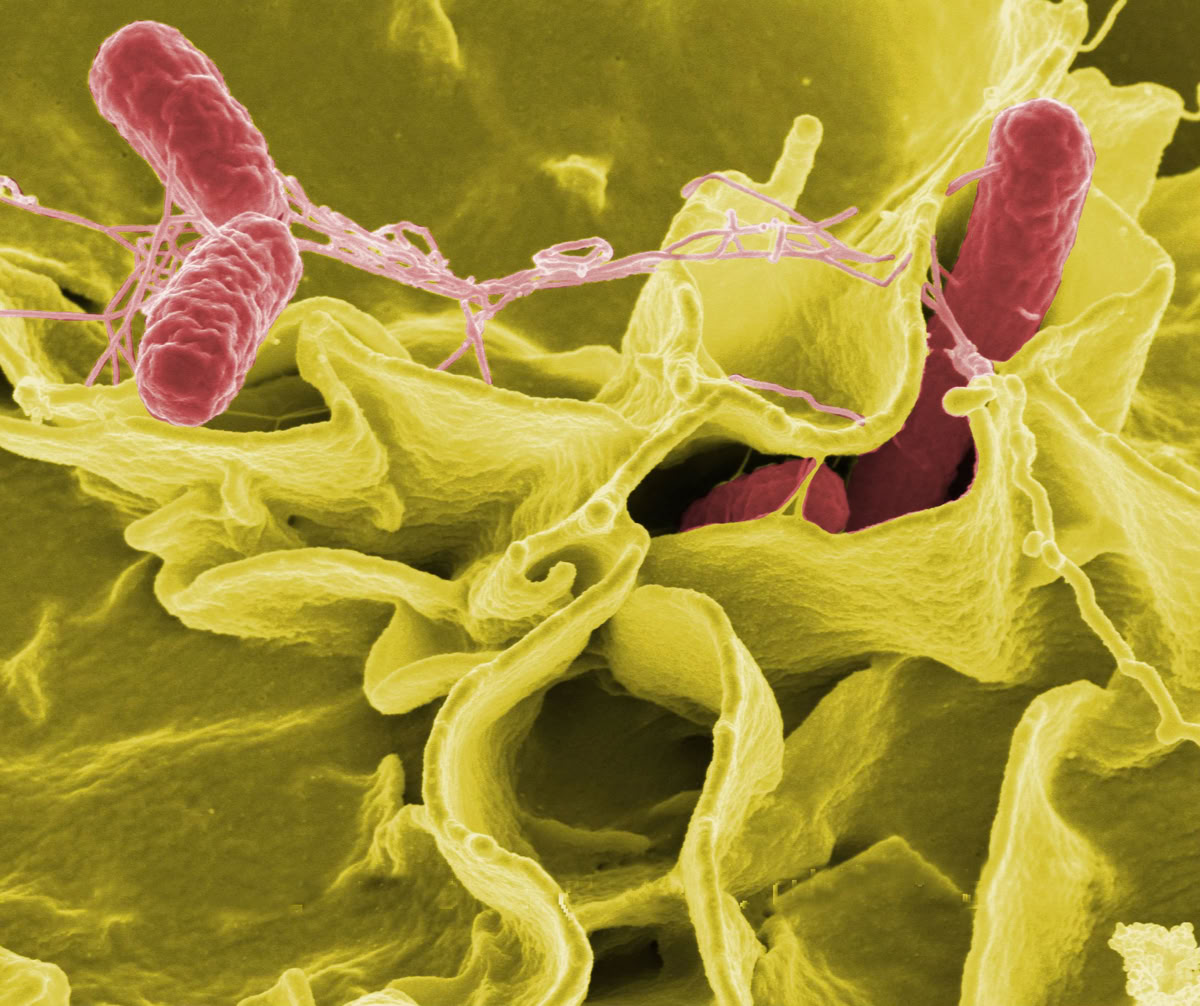
FIGURE 11.3 Bacteria are prokaryotic organisms that consist of only a single cell. Bacteria exist on or in almost every substance and environment found on Earth; this includes the exterior and interior surfaces of large organisms, soil, water, ice, and air. Each square centimeter of human skin contains about 100,000 bacteria. Some types of bacteria cause disease in humans. The image shows the bacteriumSalmonella typhimurium (colored red). This organism is responsible for many cases of food poisoning in humans. Image Source: National Institutes of Health, United States Department of Health and Human Services.


FIGURE 11.7 A lichen is an organism formed by the symbiotic association between a photosynthetic green alga and a fungus. In this relationship, the algae supply the fungus with sugar produced by photosynthesis. The fungus provides the alga with all the conditions it needs to grow, while protecting it from the more severe external environment. Image Copyright: Michael Pidwirny.

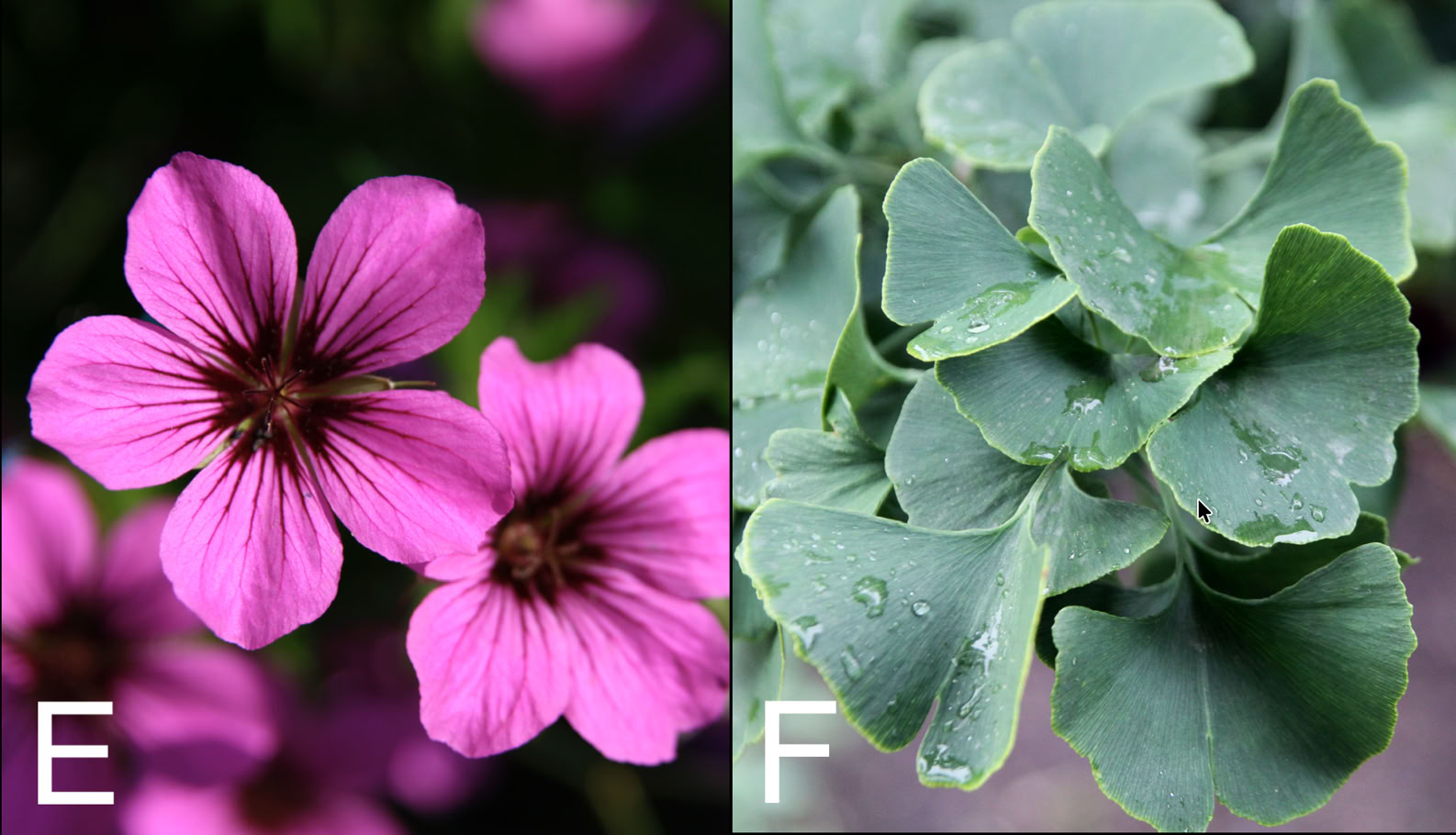
FIGURE 11.8 The dominant types of plants include mosses (A), ferns (B), horsetails (C), gymnosperms (D), angiosperms (E), and ginkgoes (F). Plants have an extremely important role in terrestrial and aquatic habitats. Through photosynthesis, they create a significant proportion of the organic molecules that will cycle through the food webs of most ecosystems. Thus, plants ultimately enable many heterotrophic organisms to survive. Image Copyright: Michael Pidwirny.

FIGURE 11.4 Protists show remarkable variation in structure and function. At the cellular level, many protists are extremely complex and, in many ways, equivalent to some multicellular plants and animals. Protists can also be multicelled. The image above shows a paramecium, one example of the more than 60,000 known species of single-celled protists. Image Source: Wikimedia Commons, photo by Barfooz. This image is licensed under the Creative Commons Attribution-Share Alike 3.0 Unported license.
FIGURE 11.5 Protists can also be multicellular.. Two examples of multicelled protists are shown: A) Brown Algae - Fucus sp., and B) Slime Mold - Fuligo sp. Image Copyright: Michael Pidwirny.
FIGURE 11.6 Fungi have a eukaryotic cell type, and most are multicellular, like the mushroom species shown above. Fungi absorb the nutrients they require for growth and reproduction from their surrounding environment. To aid nutrient absorption, fungi release enzymes that break down complex organic molecules into simpler compounds. Image Copyright: Michael Pidwirny.
FIGURE 11.9 Some examples of organisms that belong to the kingdom Animalia: A) Insects - Butterfly; B) Starfish; C) Birds; and D) Primates – Feral Human. Image Copyright: Michael Pidwirny.