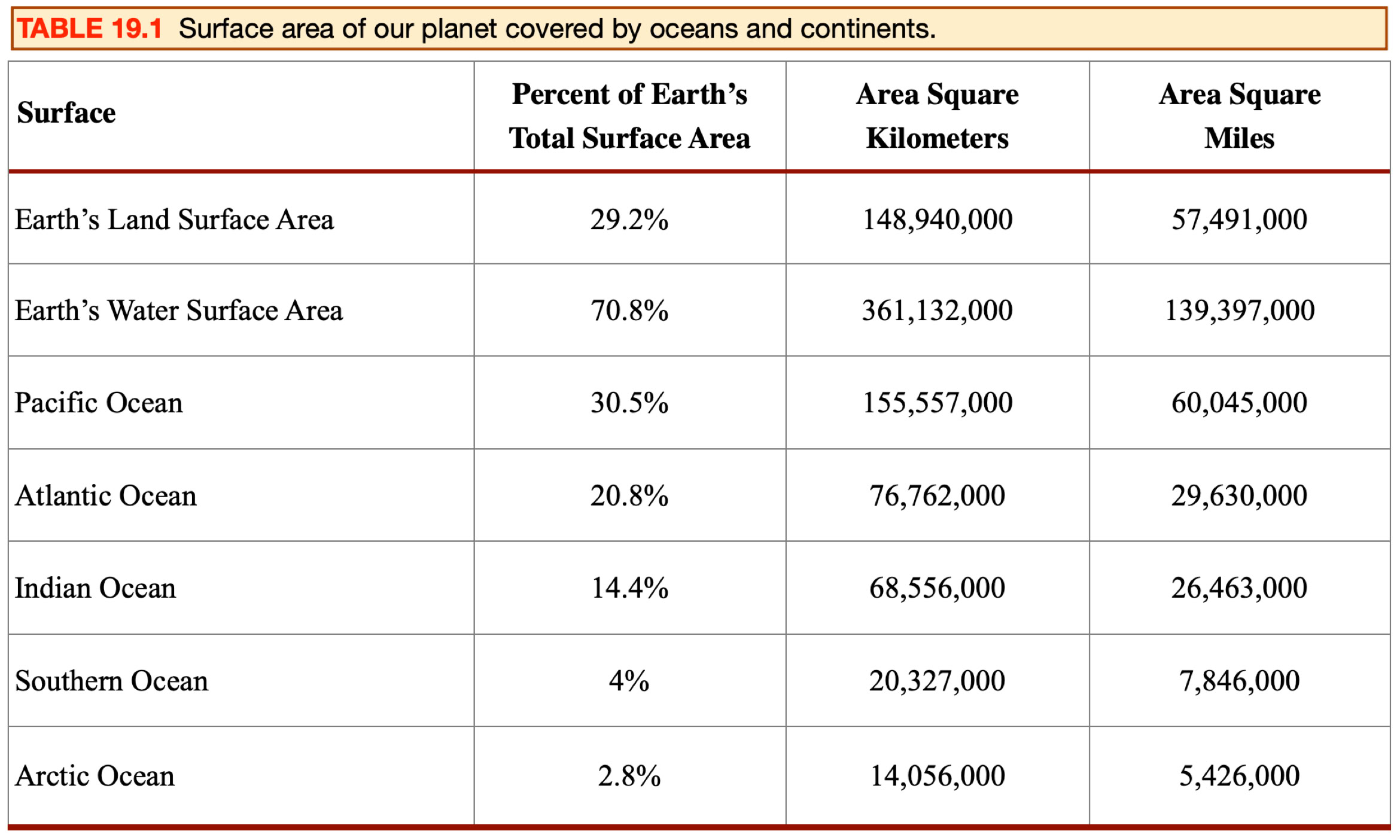
From space, our planet's surface appears dominated by the color blue. The Earth appears blue because large bodies of saline water, known as oceans, dominate the planet's surface. Oceans cover approximately 70.8% or 361 million square kilometers (139 million square miles) of Earth's surface (Table 19.1), with a volume of about 1370 million cubic kilometers (329 million cubic miles). The average depth of these extensive bodies of seawater is about 3.8 kilometers (2.4 miles) (Figure 19.1). Maximum depths can exceed 10 kilometers (6.2 miles) in several areas known as ocean trenches. The oceans contain 97% of our planet's available water. The other 3% is found in the atmosphere, on the Earth's terrestrial surface, or in the Earth's lithosphere in various forms and stores (see Chapter 16).
The spatial distribution of ocean regions and continents is unevenly arranged across the Earth's surface (Figure 19.2). In the Northern Hemisphere, the ratio of land to ocean is about 1:1.5. The ratio of land to ocean in the Southern Hemisphere is 1 to 4. This greater abundance of the ocean surface has some fascinating effects on the environment of the southern half of our planet. For example, the climate of Southern Hemisphere locations is often more moderate than that of similar places in the Northern Hemisphere. This situation is primarily due to large amounts of heat energy stored in the oceans.
The International Hydrographic Organization has divided the world's interconnected oceans into five main regions: the Atlantic, Arctic, Indian, Pacific, and Southern Oceans. Each of these regions differs from the others in some specific ways.
Atlantic Ocean
The Atlantic Ocean is a relatively narrow body of seawater that snakes between nearly parallel continental masses and covers about 21% of the Earth’s total surface area (Figure 19.3). This ocean contains most of our planet’s shallow seas but has relatively few islands. Some shallow seas in the Atlantic Ocean include the Caribbean, Mediterranean, Baltic, Black, Irish, North, and the Gulf of Mexico. The average depth of the Atlantic Ocean (including its adjacent seas) is about 3300 meters (10,800 feet). The deepest point, 8605 meters (28,232 feet), occurs in the Puerto Rico Trench. The Mid-Atlantic Ridge, running roughly down the center of this ocean region, separates the Atlantic Ocean into two large basins.
Many streams empty their freshwater discharge into the Atlantic Ocean. In fact, the Atlantic Ocean receives more freshwater from terrestrial runoff than any other ocean region. This ocean region also drains some of the Earth’s largest rivers, including the Amazon, Mississippi, St. Lawrence, and Congo. The surface area of the Atlantic Ocean is about 1.6 times that of the terrestrial areas that provide runoff.
Arctic Ocean
The Arctic Ocean is the smallest of the world’s five ocean regions, covering about 3% of the Earth’s total surface area. Most of this nearly landlocked ocean region is north of the Arctic Circle (Figure 19.4). The Arctic Ocean is connected to the Atlantic Ocean by the Greenland Sea and the Pacific Ocean via the Bering Strait. The Arctic Ocean is also the shallowest ocean basin, with an average depth of 1050 meters (3,450 feet). The center of the Arctic Ocean is covered by a drifting, persistent floating surface of sea ice with an average thickness of about 3 meters (10 feet). During winter, this sea ice covers much of the Arctic Ocean (Figure 19.5). Higher summer temperatures cause the sea ice to shrink by about 50% each year.
Indian Ocean
The Indian Ocean covers about 14% of the Earth’s surface area. This ocean region is enclosed on three sides by the landmasses of Africa, Asia, and Australia (Figure 19.6). The Indian Ocean’s southern border is open to water exchange with the much colder Southern Ocean. The average depth of the Indian Ocean is 3900 meters (12,800 feet). The deepest point in this ocean region is the Java Trench, at 7258 meters (23,812 feet) below sea level. The Indian Ocean region has relatively few islands. Continental Shelf areas tend to be narrow, and few shallow seas exist. Relative to the Atlantic Ocean, only a small number of streams drain into the Indian Ocean. Consequently, the surface area of the Indian Ocean is approximately 400% larger than the land area supplying runoff into it. Some of the major rivers flowing into the Indian Ocean include the Zambezi, Arvandrud/Shatt-al-Arab, Indus, Ganges, Brahmaputra, and the Irrawaddy. Seawater salinity ranges between 32 and 37 parts per thousand (ppt). Because much of the Indian Ocean lies within the tropics, this basin has the warmest surface ocean temperatures.
Pacific Ocean
The Pacific Ocean is the largest ocean region (Figure 19.7), The Pacific Ocean is the largest ocean region (Figure 19.7), covering about 30% of the Earth’s surface area (about 15 times the size of the United States). The Pacific Ocean floor is relatively uniform in depth, with an average depth of 4300 meters (14,100 feet) below sea level. This fact makes it the deepest ocean region on average. The Pacific Ocean is also home to the lowest elevation on our planet. The deepest point in the Mariana Trench lies some 10,971 meters (35,994 feet) below sea level, as recorded by a sonar multibeam bathymetry system on June 1, 2009. About 25,000 islands can be found in the Pacific Ocean region, more than the number for the other four ocean regions combined. Many of these islands are the tops of volcanic mountains (like the Hawaiian Islands), formed by the eruption of molten rock from beneath the ocean floor.
Relative to the Atlantic Ocean, only a small number of rivers add terrestrial freshwater runoff to the Pacific Ocean. In fact, the surface area of the Pacific is about 1000% greater than the land area that drains into it. Some of the major rivers flowing into this ocean region include the Colorado, Columbia, Fraser, Mekong, Río Grande de Santiago, San Joaquin, Shinano, Skeena, Stikine, Xi Jiang, and Yukon. Some of the larger adjacent seas connected to the Pacific are Celebes, Tasman, Coral, East China, Sulu, South China, Yellow, and the Sea of Japan.
Southern Ocean
The Southern Ocean surrounds Antarctica, extending to the latitude 60° South (Figure 19.8). This ocean region covers about 4% of Earth's surface, or about 20,327,000 square kilometers (7,846,000 square miles). Compared to other ocean regions, the floor of the Southern Ocean is quite deep, ranging from 4000 to 5000 meters (13,100 to 16,400 feet) below sea level over most of its area. Continental Shelf areas are very limited and are mainly found around Antarctica. But even these areas are pretty deep, with an elevation between 400 and 800 meters (1300 and 2600 feet) below sea level. For comparison, the average depth of the Continental Shelf worldwide is about 130 meters (425 feet). The Southern Ocean's deepest point is in the South Sandwich Trench at 7235 meters (23,737 feet) below sea level. Seas adjacent to this ocean region include the Amundsen, Bellingshausen, Ross, Scotia, and the Weddell Sea. By about September each year, a mobile floating surface of sea ice around Antarctica reaches its seasonal maximum, covering about 19 million square kilometers (7 million square miles). This sea ice shrinks by about 85% in March, six months later.

FIGURE 19.1 The relative percentage of Earth’s surface at various elevations above and below sea level. Also shown on this graph are some important land elevations and ocean depths. Image Copyright: Michael Pidwirny.

FIGURE 19.2 The relative distribution of land and water covering the Earth’s surface according to latitude. Image Copyright: Michael Pidwirny.

FIGURE 19.3 Atlantic Ocean region. Image Source: CIA World Factbook.

FIGURE 19.4 Arctic Ocean region. Image Source: CIA World Factbook.


FIGURE 19.6 Indian Ocean region. Image Source: CIA World Factbook.

FIGURE 19.7 Pacific Ocean region. Image Source: CIA World Factbook.
FIGURE 19.5 Computer-generated visualization showing the Arctic sea ice surface coverage on March 24, 2016. Image Source: NASA - Scientific Visualization Studio.
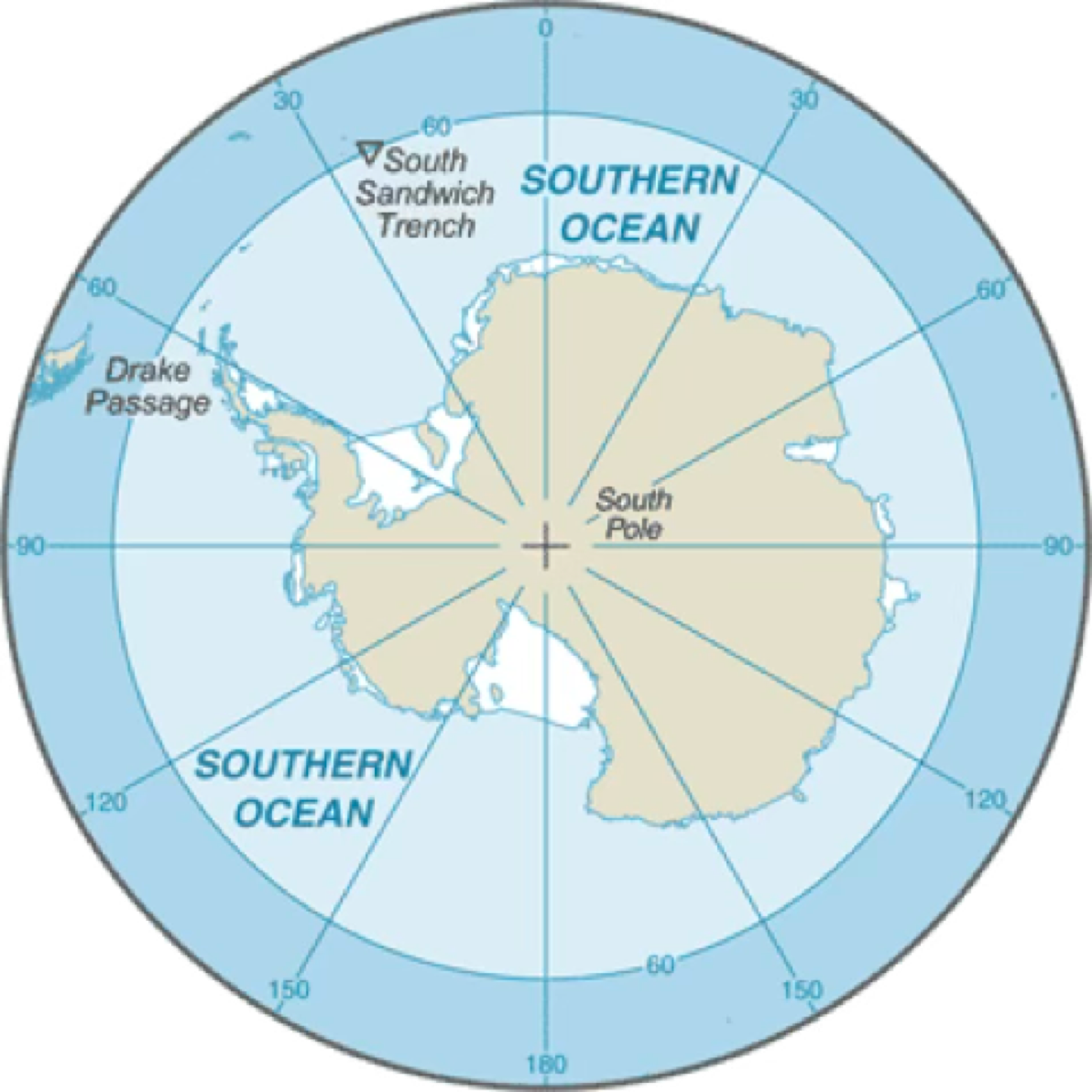
FIGURE 19.8 Southern Ocean region. Image Source: CIA World Factbook.