FIGURE 12.6 The House Sparrow (Passer domesticus) is an excellent example of a generalist species. This bird is originally native to the Middle East and spread with the expansion of agriculture to Europe, Asia, and Northern Africa. Because of its generalist characteristics, this bird species was easily introduced by humans to many other parts of the world. It can now be found in North and South America, sub-Saharan Africa, and Australia. Image Copyright: Michael Pidwirny.
Geographic Range
Each species on our planet occupies a unique geographic range, where its various populations live, feed, and reproduce. Some species have extensive geographic ranges spanning several continents. Species with such distributions are known as cosmopolitan species (Figure 12.1). Other species can have more restricted geographic ranges, isolated to a small area on a single continent. This type of distribution is termed endemic (Figure 12.2).
Geographic ranges of organisms continually expand, contract, and shift over time (Figure 12.3). These changes are caused by two contrasting processes: extinction and establishment. The establishment of a species takes place when individuals colonize new areas and can maintain reproductively viable populations. New suitable habitats for establishment may open up due to abiotic and biotic environmental changes. Species are constantly attempting to expand their spatial distribution, as this improves their chances of long-term survival.
Extinction is a process that eliminates members of a species from all or part of its geographic range. Extinction occurs when large numbers of individuals from a species are killed by biotic interactions or abiotic environmental change. Limited extinctions occurring within small sub-regions of a species’ range are usually quite common.
Ecological Niche
For a species to maintain its population, its individuals must survive and reproduce over time. Certain combinations of environmental conditions are necessary for this to occur. Individuals within a species must tolerate the physical environment, obtain energy and nutrients, and avoid competitors and predators. The total requirements of a species for all resources and physical conditions determine where it can live and how abundant it can be at any one place within its geographic range. These requirements are referred to as the ecological niche.
Ecologist G.E. Hutchinson in 1958, suggested that the ecological niche could be viewed as an imaginary space with many dimensions. Each dimension or axis in this imaginary space represents the range of some environmental condition or resource that is required by the species. Thus, the ecological niche of a plant might include the range of temperatures it can tolerate, the intensity of light required for photosynthesis, specific humidity regimes, and the minimum levels of essential soil nutrients required for uptake and growth. While this idea sounds a bit complex, it can be simply explained with the following illustration (Figure 12.4).
A useful extension of the ecological niche idea is the distinction between fundamental and realized niches (Figure 12.5). A species' fundamental niche includes the total range of environmental conditions suitable for existence without the influence of competition or predation from other species. The realized niche describes the part of the fundamental niche that is actually occupied by the species. This type of niche does include the effects of competitive interactions and predation. Many species occupy only a portion of their fundamental niche because biotic interactions restrict their presence in these sites. Also, organisms may not occupy parts of their fundamental niche because they have never colonized these sites. For example, American Bison (Bison bison) are not found in the grasslands of Argentina because they have never been able to migrate there.
Some species, like the House Sparrow (Passer domesticus), have a broad fundamental niche and are adapted to survive in many different types of habitats. Consequently, these generalist species can tolerate a wide range of environmental conditions (Figure 12.6). At the other end of the spectrum, some species, such as the Mountain Gorilla (Gorilla gorilla), have a narrow fundamental niche and therefore have specific resource requirements. These types of organisms are known as specialist species (Figure 12.7). In terms of geographic range, generalists tend to have much larger ranges than specialists.
Finally, a species' ecological niche can change over time due to competition and evolutionary forces. Through mutation, species can add new adaptations that may make them successful under different environmental conditions. The need to find a slightly different ecological niche is often due to competitive forces. When two different species compete for the same resource, the long-term outcome is the competitive exclusion of the species that is less capable of consuming the resource. However, if the necessary genetic mutations occur, the two competing species may diverge in their resource requirements over time. This divergence would allow both species to coexist in the same habitat as they have now developed different resource requirements for survival (Figure 12.8). This evolutionary process is known as resource partitioning.

FIGURE 12.1 The Painted Lady butterfly (Vanessa cardui) is found on every continent except Antarctica. Given its relatively extensive geographic range, we would classify this organism as a cosmopolitan species. Image Source: Wikimedia Commons, photo by Joaquim Alves Gaspar. This Image is licensed under the Creative Commons Attribution-Share Alike 3.0 Unported license.
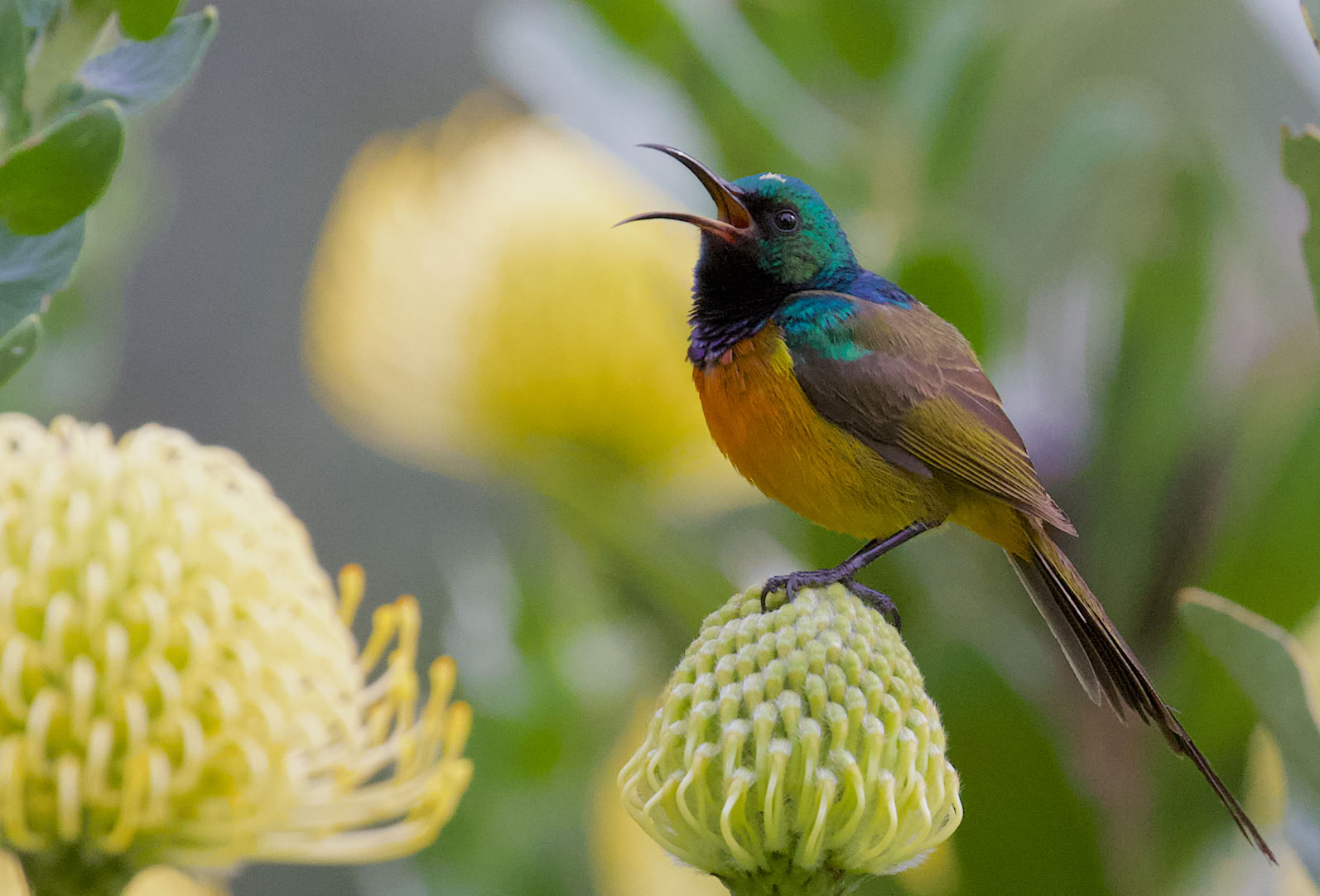
FIGURE 12.2 An endemic species has a geographic range exclusive to a relatively small area on our planet. The Orange-breasted Sunbird (Anthobaphes violacea) is an endemic species found only in southern Africa. Image Source: Wikimedia Commons, photo by Gregory Smith. This image is licensed under the Creative Commons Attribution-Share Alike 2.0 Generic license.


FIGURE 12.4 Diagram A represents a simple ecological niche for a species with only two niche dimensions: moisture and temperature. Diagrams B and C illustrate how the availability of temperature and moisture effect population growth. Image Copyright: Michael Pidwirny.

FIGURE 12.5 The diagram above shows a hypothetical situation where a species distribution is controlled by just two environmental variables: temperature and moisture. The combined blue and orange areas indicate the temperature and moisture levels the species requires for successful survival and reproduction in its habitat. This resource space is known as the fundamental niche. The blue area describes the actual combinations of these two variables that the species utilizes in its habitat. This subset of the fundamental niche is known as the realized niche. Image Copyright: Michael Pidwirny.


FIGURE 12.7 Mountain Gorillas (Gorilla gorilla) have highly specialized habitat requirements. The Mountain Gorilla is only found in the highland jungles of Zaire, Rwanda, and Uganda. Image Source: Wikimedia Commons, photo by Giles Laurent. This image is licensed under the Creative Commons Attribution-Share Alike 4.0 International license.

FIGURE 12.8 Situations can arise where the niches of two or more species can overlap. In this niche overlap, the interacting species have similar requirements for the resource. This similarity will lead individuals of the interacting species to engage in resource competition (green area in illustration A). Because of competition, these individuals will also be less successful in reproduction. Over time, this situation will cause the populations of these species to diverge from one another through natural selection (illustration B). Image Copyright: Michael Pidwirny.
FIGURE 12.3 Climate changes often modify the geographic range of organisms. Over the last 50 years, the geographic range of the Mountain Pine Beetle (Dendroctonus ponderosae) has expanded northward across western North America due to global warming. In 2005, the Mountain Pine Beetle infected 8.7 million hectares of trees in British Columbia, Canada. Before the recent warming, this insect was rarely found in this region of North America because cold winter temperatures prevented its migration. A – Adult Mountain Pine Beetle. B – Infested Lodgepole Pine (Pinus contorta) trees. Image Source A: USDA Forest Service - Region 4 Archive, USDA Forest Service, forestryimages.org, Image Source B: USDA Forest Service, forestryimages.org, photo by Daniel Miller. These works are licensed under a Creative Commons Attribution 3.0 License.