Earth Science is the study of Earth’s surface, interior, atmosphere, hydrosphere, biosphere, oceans, and the processes that shape them. Its objective is to comprehend how our planet works and has transformed over time. A defining feature of Earth Science is its interdisciplinary nature. It integrates physics, chemistry, biology, and mathematics to study Earth’s four spheres: the geosphere, hydrosphere, atmosphere, and biosphere. This systems-based approach enables scientists to explain phenomena like plate tectonics, weather patterns, atmospheric circulation, ocean currents, and the evolution of life.
Individuals studying the Earth Sciences are rarely generalists. Most are highly specialized in their fields of knowledge and tend to focus on one of the following well-defined areas of understanding in Earth Sciences. These well-defined areas of study include:
Geology - is the scientific study of the Earth's composition, structure, geologic history, and the processes that influence our planet's interior and exterior.
Geomorphology - studies the various landforms on the Earth's surface.
Meteorology - studies the physical and chemical processes that operate in the atmosphere over short periods.
Climatology - studies the effects of weather on life and examines the condition of the atmosphere over more extended periods.
Hydrology - the field of knowledge that is interested in studying water in all its forms.
Biogeography - is the science of investigating the spatial relationships of life on our planet.
Oceanography - the science that examines the biology, chemistry, physics, and geology of oceans.
Pedology - is concerned with the investigation of soils.
The above fields of knowledge generally play a primary role in introductory textbooks dealing with earth science. Introductory earth science textbooks can also contain information from other related disciplines, including:
Ecology - the investigation of the interactions between organisms and their environment.
Cartography - the field of knowledge that studies the various techniques for designing and constructing maps.
Astronomy - the science that describes the objects found in the Universe and tries to understand the processes influencing celestial bodies and the cosmos.
Finally, Earth Science provides an essential intellectual background for studying the environment. Webster's 11th Collegiate Dictionary defines environment "... as the complex of physical, chemical, and biotic factors (such as climate, soil, and living things) that act upon an organism or an ecological community and ultimately determine its form and survival." Many environmental studies/science programs offered by universities and colleges worldwide use information from various earth science courses to educate their students about the state of our planet's environment.
The Four Spheres
At the global level, Earth scientists view the Earth as composed of four different functioning parts: the atmosphere, the hydrosphere, the lithosphere, and the biosphere. Each of these spheres is often studied somewhat independently of the others. Consequently, the discussion in this textbook is organized according to this idea. A closer examination of the phenomena that operate in each of these parts reveals that the spheres often interact with one another at different functional scales. Many of these interactions will be discussed as we progress through this website. It will also become quite apparent that modern humans are actively influencing several of these interactions at local, regional, and even global scales.
The Atmosphere
The atmosphere is the vast gaseous air envelope surrounding the Earth (Figure 1.1). The atmosphere contains a complex mixture of gases and suspended particles that behave in many ways like fluids. Many of its constituents are derived from the Earth through chemical and biochemical reactions. The atmosphere is also the sphere where our planet's weather operates. Some of the essential elements of the atmosphere include temperature, precipitation, wind, pressure, and humidity.
The Hydrosphere
The hydrosphere describes the nature of water on our planet (Figure 1.2). Water exists on the Earth in various stores. Some important stores include the atmosphere, oceans, lakes, streams, soils, snow, glaciers, and groundwater. Water is transferred from one store to another through processes like evaporation, transpiration, condensation, runoff, precipitation, infiltration, and groundwater flow. Humans have greatly influenced the hydrosphere by altering the runoff process to supply water for domestic, industrial, commercial, and agricultural needs.
The Lithosphere
The definition of lithosphere used by most geoscientists suggests that it is the rigid outer layer of the Earth's crust that floats on top of more plastic, semi-liquid inorganic materials (Figure 1.3). In this discussion of Earth's spheres, we will define the lithosphere as the solid inorganic portion of Earth. Inorganic matter in the lithosphere organizes into definable units known as minerals and rocks. Earth scientists have had a long history of studying the landforms found on the surface of the lithosphere. Many of these studies have investigated the processes that determine how the various landforms form.
The Biosphere
The biosphere comprises all living things, plants, and animals (Figure 1.4). This sphere is characterized by life in abundance, diversity, and clever complexity. Through evolution, life has developed a variety of adaptations that enable it to inhabit and survive in the hydrosphere, atmosphere, and lithosphere. One form of life, humans, is now a critical controlling force on the Earth. This domination is influencing other forms of life, the atmosphere, the hydrosphere, and the lithosphere in various ways. Some human activities threaten the future quality of life for people and the different plants and animals that live on this planet.
FIGURE 1.3 Ejection of Pahoehoe lava approximately 10 meters (30 ft) high in Hawaii. The lithosphere is the solid portion of the Earth made of minerals and rocks. In reality, only a thin layer of the lithosphere is cool enough to be solid. Beneath this crust, high temperatures and pressure cause the inorganic matter that makes the lithosphere melt. When this hot, semi-liquid material seeps up to the Earth's surface, we call it magma. Magma solidification forms new minerals and rocks at and near Earth's surface. Image Source: Wikipedia, United States Geological Survey.

FIGURE 1.4 All of the living organisms found on our planet make up the biosphere. Through evolution, life has developed adaptations that enable it to survive even in the most extreme environments. Emperor Penguin in Adelie Land, Antarctica. Image Source: Wikimedia Commons, photo by Samuel Blanc. This image is licensed under the Creative Commons Attribution-Share Alike 3.0 Unported license.
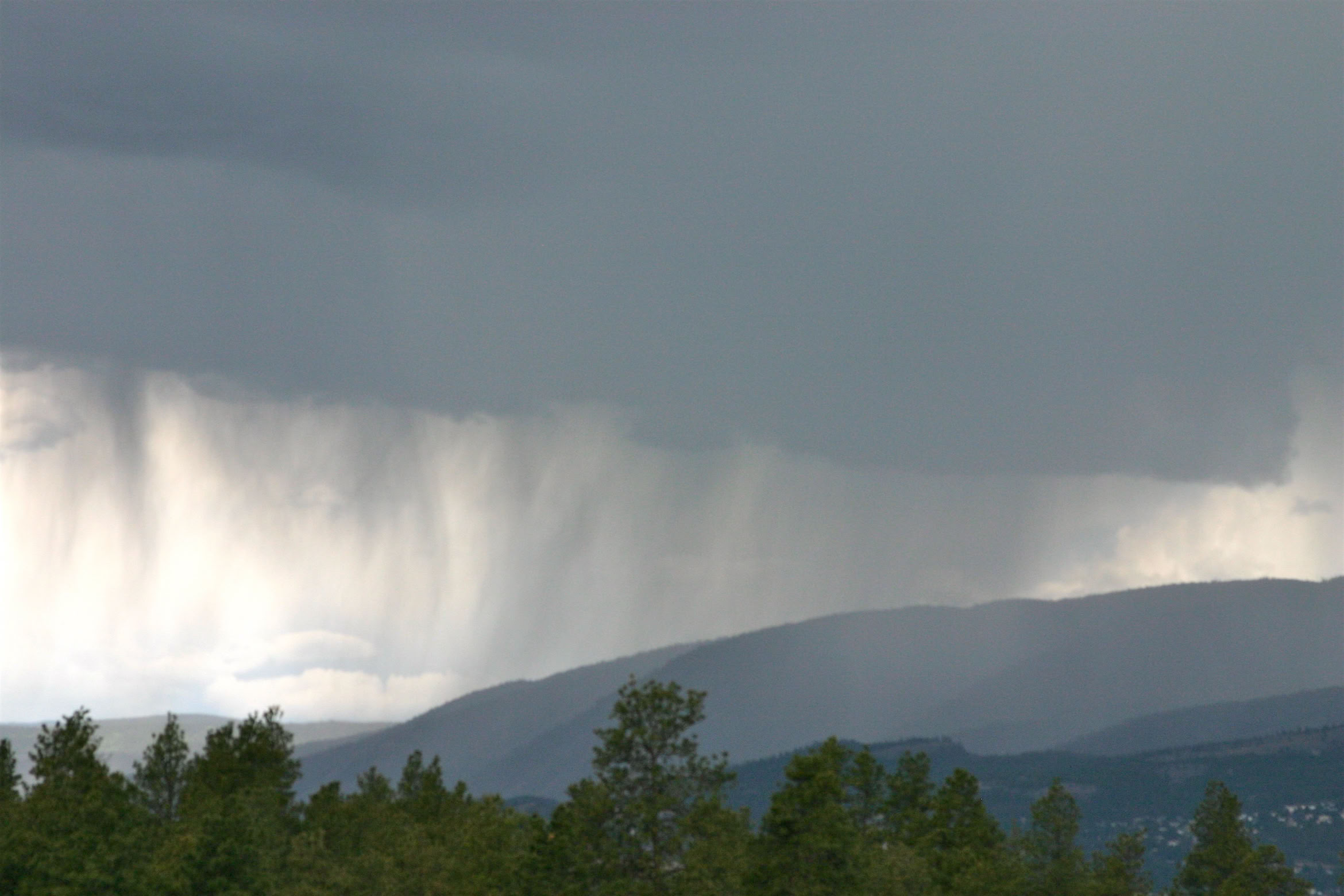
FIGURE 1.2 The hydrosphere consists of all the water that is found on our planet. Some important stores of water include the ocean, atmosphere, lakes, streams, snow, groundwater, and glacial ice on Earth's terrestrial surface. In the image above, we can see rain falling from a cloud in the atmosphere to the ground. Image Copyright: Michael Pidwirny.


FIGURE 1.1 The atmosphere is a thin layer of gases and airborne particles that exists above the Earth's solid surface. The atmosphere is also the place where our planet's weather occurs. Image Source: NASA.