Our planet’s atmosphere has no clear-cut upper edge. The air gradually becomes less dense with increasing height. We can suggest that the atmosphere has several layers. These layers can be defined according to vertical changes in air temperature or chemical composition.
Thermal Layers
Figure 5.7 shows the thermal layers of the atmosphere, including four main layers and three transition zones. The first identifiable layer above the Earth's surface is the troposphere. The depth of this layer varies considerably with latitude and season. The troposphere is about 16 km (10 mi) thick at the equator. Above the Earth's polar regions, the troposphere reaches an altitude of only 8 km (5 mi). The average thickness of this layer from the surface of the Earth is approximately 11 km (6.8 mi). The troposphere is also thicker in summer than in winter. During the warm summer season, the thermal expansion of the lower atmosphere and the presence of dominant warm updrafts raise the upper boundary of this layer.
About 80% of the atmosphere's mass is in the dense troposphere. The troposphere is also the layer where most of our weather occurs. The circulation of air in this zone occurs vertically as well as horizontally. Vertical mixing of the troposphere is most evident during summer when intense solar radiation generates convective thermals near the Earth's surface. Some of these buoyant parcelsof air can create cumulus or cumulonimbus clouds (thunderstorms) under the right conditions (Figure 5.8).
Air temperature generally decreases with altitude in the troposphere. The average global ground-level temperature is about 15°C (59°F). With increasing altitude, air temperature drops uniformly at an average rate of 6.5°C per 1000 m (3.6°F per 1000 ft). An average temperature of -57°C (-71°F) is reached at the top of the troposphere. Actual rates of tropospheric temperature change vary with altitude, location, and time of year. Each of these rates is called an environmental lapse rate (ELR). Meteorologists measure the environmental lapse rate for various locations worldwide twice daily. These measurements are used to forecast future surface air temperatures and to determine the likelihood of thunderstorm formation and other weather conditions. Overnight cooling near the ground often produces an environmental lapse rate, in which temperature increases with height for several hundred meters above the surface before beginning to cool again. This common atmospheric phenomenon is known as a temperature inversion (Figure 5.9). Temperature inversions inhibit the upward movement of air and can concentrate air pollutants near the Earth's surface.
Near the top of the troposphere lies a transition zone where air temperature does not change with altitude for about 9 km (5.6 mi). Such zones in the atmosphere are called isothermal layers. This first isothermal layer is called the tropopause. The tropopause is the atmospheric layer where fast-moving, meandering air streams called jet streams occur.
The next thermal layer in the atmosphere is called the stratosphere. This layer accounts for about 20% of the atmosphere's total mass and extends to altitudes of 20 to 50 km (12 to 30 mi) above Earth's surface. Minimal weather and vertical mixing occur in this layer of the atmosphere. Occasionally, the top of a thunderstorm may breach the bottom of this layer. Temperature increases with altitude in the stratosphere because a localized concentration of ozone gas molecules (triatomic oxygen - O3) absorbs ultraviolet radiation from the Sun, generating heat energy. Stratospheric temperatures range from –57°C (-70°F) to 0°C (32°F) at the layer's upper boundary. The next thermal layer in the atmosphere, separating the stratosphere, is another isothermal layer called the stratopause.
Above the stratosphere is the mesosphere. The mesosphere extends from 50 to 90 km (30 to 56 mi) above the Earth’s surface. The air here is very thin and can get extremely cold. The top of this layer has an average temperature of about -90°C (-130°F). Above the mesosphere is the last isothermal layer called the mesopause.
The last atmospheric layer, with an altitude greater than 90 km (56 mi), is called the thermosphere. Temperatures in this layer can reach 1200°C (2200°F). These high temperatures are generated by the absorption of intense solar radiation by oxygen molecules (O2). While these temperatures seem extreme, the amount of heat energy in the low-density air is minimal. In ???? , we learned that the amount of heat a substance can store is partly determined by its mass. The air in the thermosphere is extremely thin, with individual gas molecules separated by large distances. Consequently, measuring the thermosphere's temperature with a thermometer is very difficult. Thermometers measure the temperature of bodies through the movement of heat energy. Normally, this process takes a few minutes to conductively transfer kinetic energy from countless molecules in the body of a substance to the expanding liquid inside the thermometer. In the thermosphere, our thermometer would lose more heat by radiative emission than it would gain from occasional contact with extremely hot gas molecules.
Chemical Layers
We can also organize the atmosphere into various layers based on chemical characteristics. From the Earth's surface to an altitude of 80 km (50 mi), the atmosphere has a fairly uniform mixture of the principal gases: nitrogen, oxygen, argon, and carbon dioxide. This zone of homogeneous composition is known as the homosphere (Figure 5.10). Above the homosphere is a layer called the heterosphere. In the heterosphere, the gases nitrogen, oxygen, helium, and hydrogen are concentrated at distinct altitudes within this layer. Their atomic weight controls the order sequence of these gases with height. The heaviest of these gases is nitrogen, which is concentrated at the bottom of this layer. The next two sub-layers are occupied by oxygen and helium, respectively. At the top of the heterosphere is a sublayer of hydrogen. Hydrogen is the lightest gas in this group.
We can also identify two other layers in the atmosphere based on chemistry. Between the altitudes of 10 and 50 km (6 and 31 mi) lies a layer in the atmosphere where ozone gas is concentrated. This zone is called the ozone layer (Figure 5.11). Ozone reaches its highest concentrations within this layer at about 25 km (15 mi) above the surface. The ozone layer is important to organisms at the Earth's surface as it protects them from the harmful effects of the Sun's ultraviolet radiation. Without the ozone layer, life as we know it could not exist on the Earth's surface.
The ionosphere occurs at a height between 60 and 400 km (40 to 250 mi) (Figure 5.11). In this relatively thick layer, there is a concentration of ions. In the ionosphere, ions are positively charged because of the energizing effects of solar radiation on gas atoms and molecules. This process also creates an abundance of free electrons. We use the electrically charged ionosphere to help transport radio waves. Certain layers of the ionosphere can reflect radio waves. By bouncing radio waves off these atmospheric regions, we can extend a transmission over hundreds of kilometers (Figure 5.12). This process works best at night because of a unique property of the ionosphere. The ionosphere is divided into three sub-layers: the D-, E-, and F-layers. The lower D- and E-layers differ from the higher F-layer in two ways. First, these two sub-layers only exist during daylight hours. Second, they can also absorb some of the radio transmission. This absorption weakens radio transmission, requiring radio stations to increase signal strength after sunrise.
The ionosphere also has a role in creating the colorful nighttime display known as the Aurora Borealis (Northern Lights) and Aurora Australis (Southern Lights). The aurora process begins with the release of clouds of subatomic particles (electrons and protons) from solar flares on the Sun into space. Some of the Sun’s subatomic particles are intercepted and captured by the Earth’s magnetic field in outer space. The magnetic field then redirects these solar particles toward the magnetic poles. At the Earth’s magnetic poles, the electrons enter the ionosphere, transferring their energy to nitrogen and oxygen gas molecules in the upper atmosphere. When enough energy is absorbed, the gas molecules begin radiating energy, and we see this as visible color bands of light (the aurora).

FIGURE 5.7 Structure of the atmosphere as defined by changes in air temperature. Variations in how temperature changes with altitude indicate the atmosphere is composed of several layers (labeled above). These variations are due to alterations in the chemical and physical nature of the atmosphere with altitude. Image Copyright: Michael Pidwirny.

FIGURE 5.8 Thunderstorm clouds reaching the top of the troposphere. Summer heating of humid air in the lower troposphere can produce cumulonimbus clouds, or thunderstorms. Vertical development of these storm clouds usually stops at the top of the troposphere. This cumulonimbus cloud was photographed on September 7, 2007, by a crew member on the International Space Station. The flat top of the cloud indicates the cloud reached the top of the troposphere. Image Source: NASA - Gateway to Astronaut Photography of Earth.
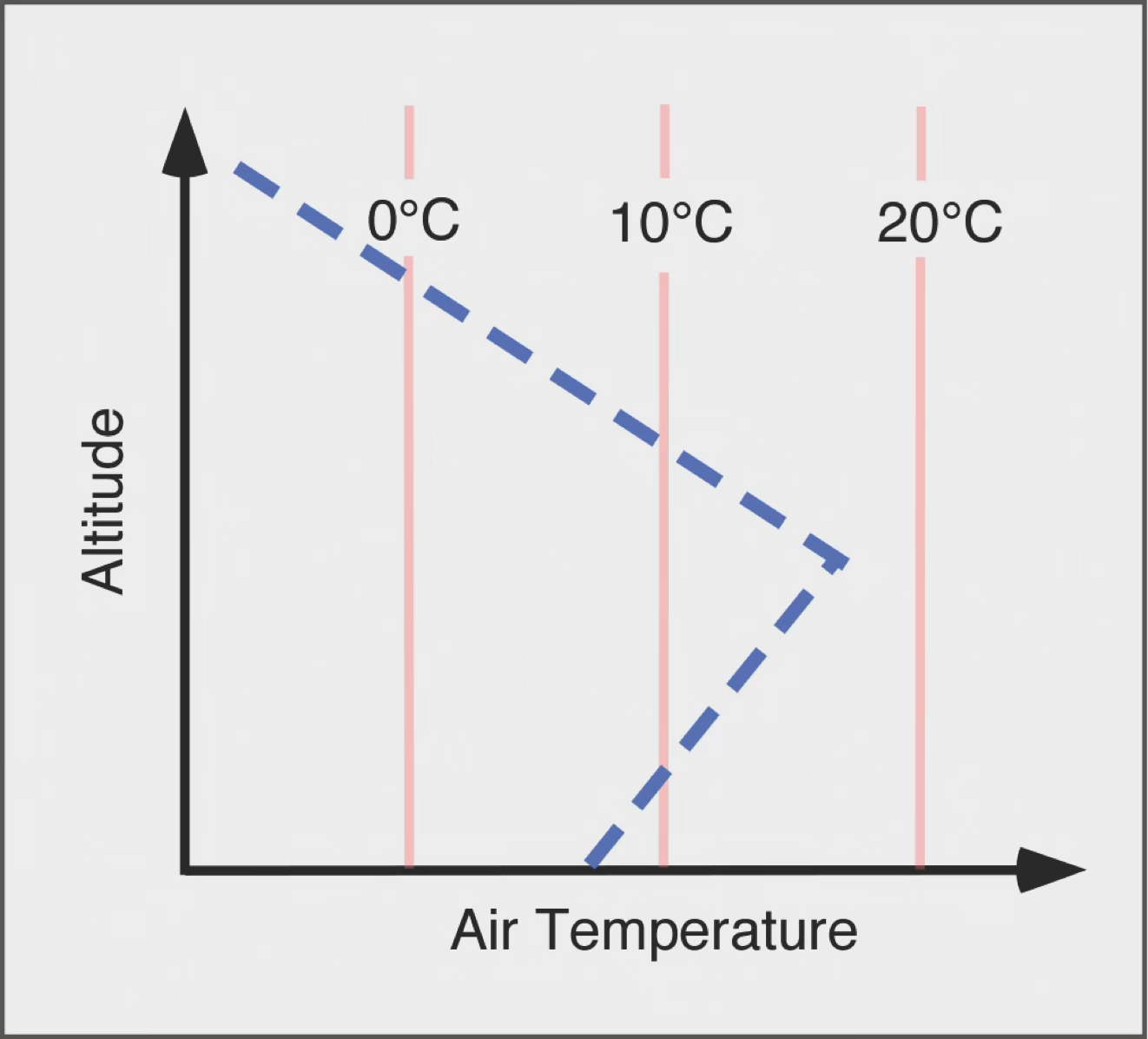
FIGURE 5.9 Temperature inversion vertical profile. A temperature inversion is a layer in the troposphere where temperature increases with height. Image Copyright: Michael Pidwirny.

FIGURE 5.10 Chemical layers in the atmosphere. The homosphere is a layer in the atmosphere defined by a uniform mixture of gases. It extends from the Earth’s surface to an altitude of about 80 km (50 mi). Above this layer is the heterosphere. In the heterosphere, gases are vertically layered by molecular mass. Image Copyright: Michael Pidwirny.

FIGURE 5.11 The ozone layer and ionosphere. The ozone layer is a region of the atmosphere where ozone is concentrated. The ionosphere is a region containing large numbers of electrically charged particles (atoms and molecules) known as ions. Image Copyright: Michael Pidwirny.
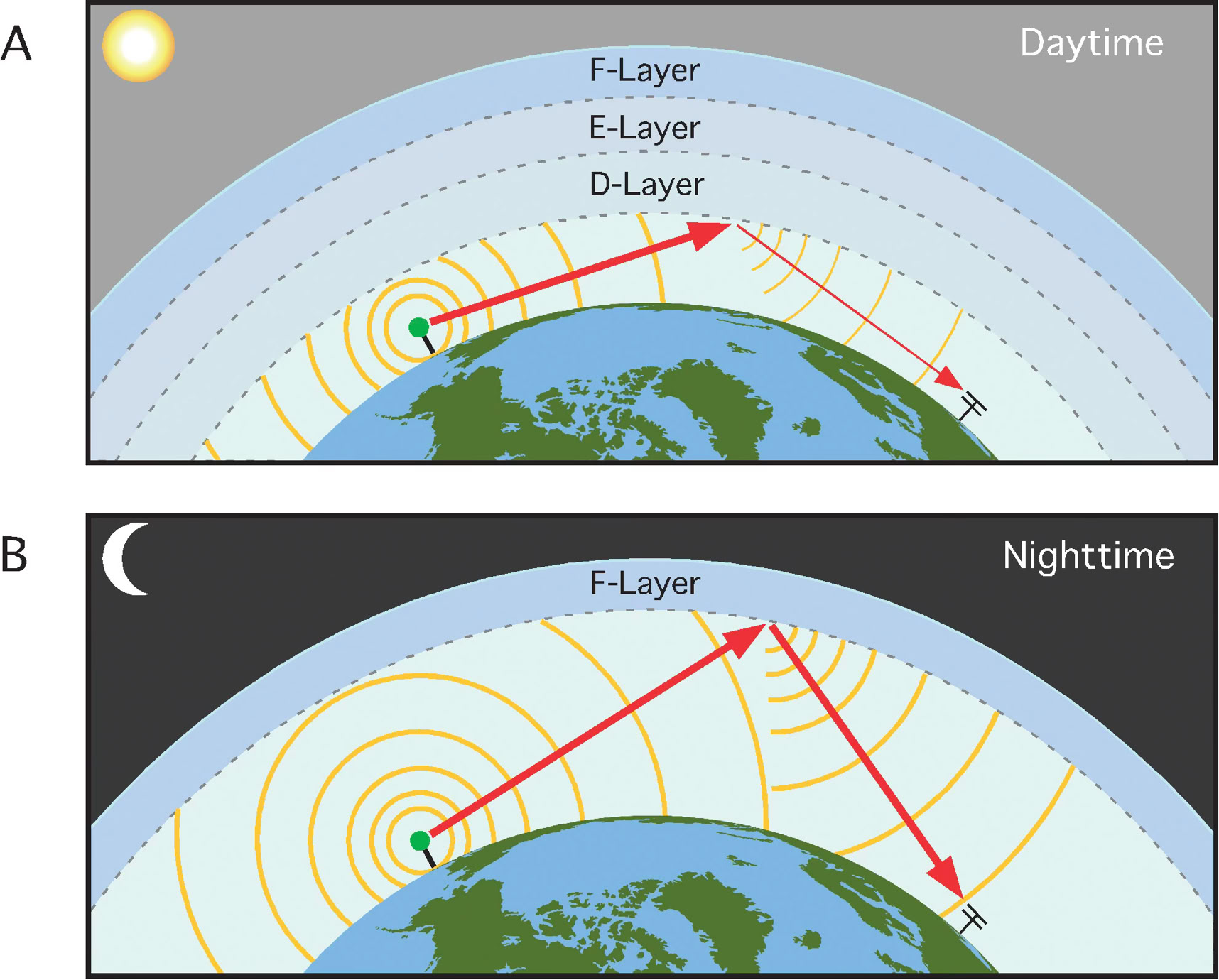
FIGURE 5.12 We use the ionosphere to help broadcast radio transmissions over long distances. By reflecting radio waves off the ionosphere, surface locations normally obscured by the Earth’s curved surface can receive transmissions. Radio signals must be strengthened during the day (A) because the D- and E-layers can partially absorb radio waves. At night (B), the D- and E-layers dissipate, and only the F-layer is used to reflect radio signals. Because very little absorption occurs in the F-layer, radio transmissions received on the Earth at night are less distorted and stronger. Image Copyright: Michael Pidwirny.