FIGURE 5.16 Non-selective scattering in a near-surface foggy atmosphere. The poor visibility or haze seen in this photograph is due to non-selective scattering of sunlight by minute water droplets in the atmosphere. Image Copyright: Michael Pidwirny.
Solar radiation passing through space reaches the edge of Earth's outer atmosphere, where it is only slightly attenuated in intensity. This alteration is caused by the fact that light travels away from the Sun's surface like an expanding sphere. The Inverse Square Law tells us that for every unit distance traveled, the intensity of solar radiation decreases to one-quarter of its original quantity (see Chapter 4 - Solar Output and the Earth).
The Earth's atmosphere is not transparent to incoming solar radiation. The atmosphere contains a variety of gases, liquid droplets of varying chemistry, and different types of solid particles. Because of these gases and particles, three atmospheric processes modify the sunlight passing through our atmosphere: scattering, absorption, and reflection.
Atmospheric Scattering
The process of scattering occurs when small particles and gas molecules diffuse part of the incoming solar radiation in random directions. This process does not alter the wavelength of the redirected solar rays (Figure 5.13). Yet, scattering reduces the amount of incoming solar radiation reaching Earth's surface. About 20% of scattered shortwave solar radiation is redirected back to space. This process is called backscattering.
Atmospheric scattering involves three separate processes. Rayleigh scattering occurs when solar insolation interacts with gas molecules at a height of about 10 km (6.2 mi) in the atmosphere. Rayleigh scattering does not influence the various wavelengths of solar radiation uniformly. This process tends to be most effective with ultraviolet and shorter visible spectrum wavelengths. As a result, Rayleigh scattering mainly redirects wavelengths that correspond to the color blue when the Sun is well above the horizon. Without Rayleigh scattering in our atmosphere, the daylight sky would appear black (Figure 5.14). This type of scattering is also responsible for the orange or red skies seen just before sunset and immediately after sunrise (Figure 5.15). When the Sun is near the horizon, its rays must travel a much longer path through the atmosphere. This increased distance causes the blue wavelengths to be completely scattered out by the time they reach an observer on Earth. Consequently, the light finally reaching the observer consists mainly of orange and red wavelengths.
Mie scattering occurs with atmospheric particulates that are 1 to 10 times larger than the wavelength of solar radiation. This type of scattering generally affects longer wavelengths of sunlight. Dust, pollen, smoke, and water droplets are the main types of particles that cause this form of scattering. As with Rayleigh scattering, most of the incident radiation is redirected in the forward direction. Mie scattering typically occurs at altitudes between 0 and 5 km (0 to 3.1 mi), where large particles tend to concentrate. Finally, Mie scattering also contributes to the red sky color at sunrise and sunset.
Sunsets are sometimes made more sensational when the atmosphere is loaded with other particles from dust storms, forest fires, and exploding volcanoes. After the eruption of Krakatau in 1883, observers worldwide described brilliant red sunsets for about three years. The increased scattering and reflection of solar insolation caused by volcanic eruptions can effectively reduce the amount of sunlight reaching Earth's surface. Satellite measurements for a significant period after the 1991 eruption of Mount Pinatubo in the Philippines recorded an increase in the amount of sunlight returned to space by the atmosphere.
Non-selective scattering takes place when large atmospheric particulates interact with incoming solar radiation. Water droplets with diameters between 5 and 100 micrometers are very effective at this type of scattering. Non-selective scattering equally influences all wavelengths in the visible and near-infrared spectrum. It produces a scatter with a color that ranges from blue to white. Reduced visibility occurs when this type of scatter is white in color (Figure 5.16). You may have observed non-selective scattering when shining a light into the fog. The water droplets in the fog redirect the light in all directions, producing a white haze and poor visibility.
Atmospheric Absorption
Some atmospheric gases, and liquid and solid particles, can absorb incoming solar radiation (Figure 5.17). Atmospheric absorption is a process in which solar radiation is retained by a substance in the atmosphere and converted into heat energy. The creation of heat energy also causes the substance to emit its own radiation. In general, the absorption of solar radiation by substances in Earth's atmosphere results in temperatures as high as 1200°C (2200°F) in the thermosphere. According to Wien's Law, bodies at this temperature or lower would emit radiation in the longwave band. Further, this radiation is emitted in all directions, so a sizable proportion of this energy is lost to space.
Absorption can occur due to the presence of atmospheric gases, aerosols, clouds, and precipitation particles. Solar radiation in the near-infrared band is especially susceptible to atmospheric absorption. Near-infrared radiation accounts for nearly 50% of the energy emitted by the Sun. Water vapor and carbon dioxide absorb almost all of this type of solar radiation within the atmosphere.
Atmospheric Reflection
The final process in the atmosphere that modifies incoming solar radiation is reflection (Figure 5.18). Atmosphericreflectionis a process where sunlight is redirected 180 degrees after it strikes an atmospheric particle. This redirection often causes a 100% loss of the insolation to space. Most of the reflection in our atmosphere occurs in clouds when light is intercepted by particles of liquid and frozen water (Figure 5.19). The reflectivity of clouds ranges from 40% to 90%, with an average of about 60%. How much light is redirected from a cloud depends on cloud thickness and the relative abundance of water droplets and ice crystals. Thicker clouds contain more particles, increasing the chance that a ray of sunlight will be reflected by a water droplet or ice crystal. When water changes from liquid to solid, its reflectivity increases significantly.
Atmospheric Transmission
The passage of radiation through the atmosphere without absorption, reflection, or backscattering into space is called atmospheric transmission. We need to realize that atmospheric transmission varies spatially and temporally. Both types of variability are due to changes in atmospheric clarity. Many natural and human-mediated processes influence atmospheric transparency. Some important natural processes include cloud development, vegetation fires, sulfide emissions from marine plankton, wind-transported dust, and volcanic eruptions. The magnitude of the effect of these natural processes on atmospheric transmission can be very significant. For example, measurements from the June 15th, 1991, volcanic eruption of Mount Pinatubo (Luzon Island, Philippines) indicate that this single event released 20 million metric tons of sulfur dioxide into the stratosphere in just a few days (Figure 5.20). This sulfur dioxide then reacted with water in the stratosphere, forming a cloud of sulfuric acid particles (Figure 5.21). By mid-August of 1991, this cloud of particles was partially obscuring 42% of the Earth’s surface from receiving sunlight. A few more months later, the cloud completely covered the planet. With less sunlight available to heat the atmosphere near the ground surface, the mean global air temperature dropped by 0.5°C (0.9°F) the following year. The cloud completely dissipated after three years.
Humans also influence the transmission of solar radiation through the atmosphere. Many gases and aerosols are released into the atmosphere from human activities. Some activities that emit large quantities of atmospheric particles include biomass burning, fossil fuel combustion, and vehicle transportation. Quantities of these particles are generally highest around cities where human populations are concentrated. The emission of these particles may significantly reduce the amount of solar radiation received in populated regions worldwide. This reduction may counter some of the increased warming predicted by the human-mediated enhancement of the greenhouse effect. Scientists refer to this process as global dimming.

FIGURE 5.13 The process of atmospheric scattering causes rays of sunlight to be redirected in a new direction after hitting a particle in the atmosphere. This illustration shows how three particles send striking light rays off in three different directions. Scattering does not change the wavelength or intensity of the striking light ray. Image Copyright: Michael Pidwirny.

FIGURE 5.14 On the moon, Rayleigh scattering does not occur because the atmosphere here is extremely thin. As a result, the moon's sky appears black even when the Sun is directly overhead. Earthset, captured through the window of the Orion spacecraft at 6:41 p.m. EDT on April 6, 2026, during the Artemis II crew’s flyby of the Moon. Image Source: NASA.

FIGURE 5.15 Red and orange skies at sunset and sunrise occur because of greater atmospheric scattering. When the Sun is at a low angle, the incoming sunlight must travel through a much thicker layer of atmosphere. As a result, sunlight undergoes much more scattering, and when it finally reaches an observer on Earth's surface, it appears orange and red. Image Copyright: Darlene Heckl.

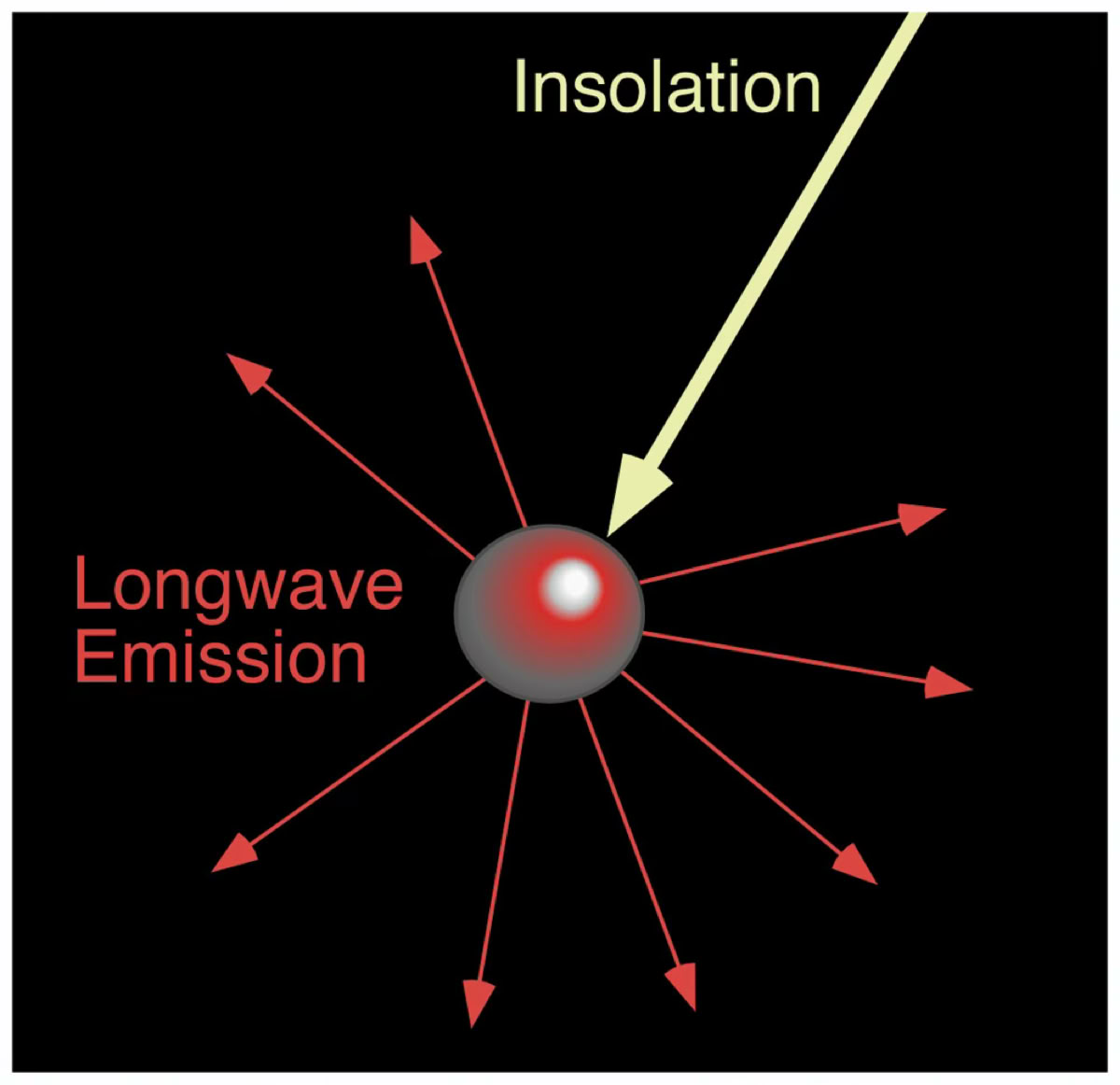
FIGURE 5.17 Atmospheric absorption is a process where sunlight is absorbed by a particle found in the atmosphere, transferred into heat energy, and then converted into longwave radiation that is emitted from the particle back to the surrounding environment. Image Copyright: Michael Pidwirny.

FIGURE 5.18 Atmospheric reflection is a process where solar radiation striking an atmospheric particle is redirected back to space unchanged. Image Copyright: Michael Pidwirny.

FIGURE 5.19 Most of the reflection in the Earth's atmosphere is caused by clouds. This overhead image from space illustrates how reflective clouds can be. The bright white color of these cumulus and cumulonimbus clouds indicates that all wavelengths of light are reflected from their surfaces into space. Image Source: NASA.

FIGURE 5.20 Eruption of Mount Pinatubo. The first of a series of major explosive eruptions of Mount Pinatubo began at 8:51 am on June 12, 1991. The largest eruption occurred on June 15. The eruption of Mount Pinatubo released millions of metric tons of ash and gas into the Earth’s atmosphere. Image Source: United States Geological Survey, Photo by Richard P. Hoblitt.
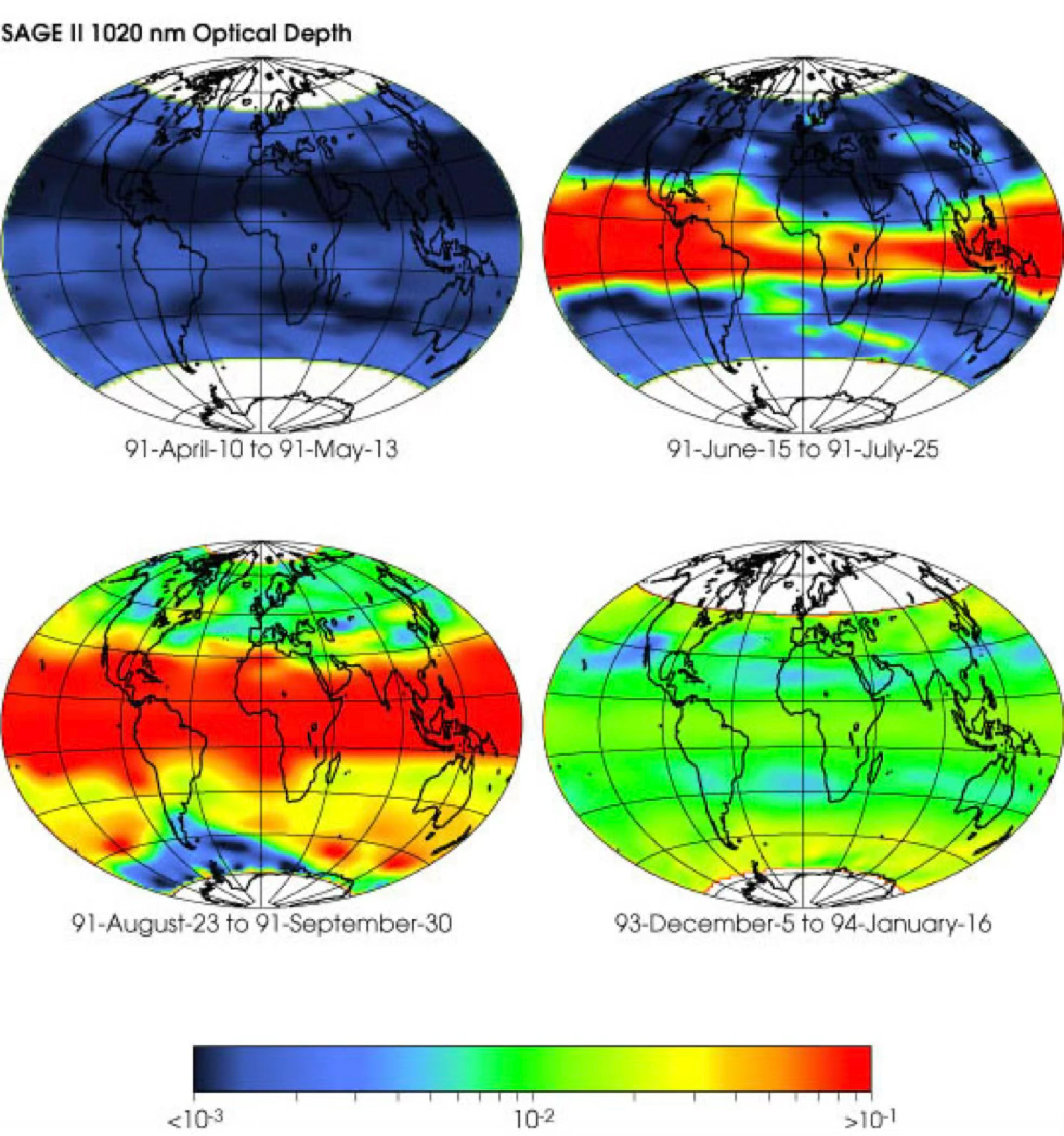
FIGURE 5.21 Mount Pinatubo aerosol cloud as seen from space. This series of images compares the optical transparency of the stratosphere as observed by NASA’s SAGE II satellite before and after the June 1991 eruption. The ejected volcanic materials were initially concentrated in the stratosphere above the tropics. Within a few months, upper-atmospheric winds spread the aerosol cloud across the entire globe. The aerosol cloud persisted in the stratosphere for almost three years. Image Source: NASA - Earth Observatory.